Over the last 2 weeks, we’ve explored how private label business platforms are transforming industries across the board — from consulting and education to healthcare, oil & gas, nonprofits, marketing agencies, financial services, and service-based businesses.
Throughout this series, one thing became very clear:
Businesses everywhere are looking for smarter ways to grow, scale, and create recurring revenue without taking on the massive burden of building software from scratch.
That’s exactly why private label partnerships are becoming one of the fastest-growing opportunities in modern business.
Businesses Want More Than Services
For years, companies relied heavily on traditional service models. Consultants billed hourly. Agencies sold projects. Coaches relied on one-on-one sessions. Advisors exchanged time for money.
While those models can be successful, they often create limitations:
- Revenue can become unpredictable
- Growth depends on hiring more people
- Client retention becomes more difficult
- Scaling operations gets complicated
- Competition increases pressure on pricing
Today’s business leaders are looking for something more sustainable.
They want systems.
They want recurring revenue.
They want platforms that keep customers engaged long after the initial service is complete.
The Rise of the Platform Business Model
The most successful companies today are no longer just selling services — they are building ecosystems around their expertise.
That shift is happening across nearly every industry.
Instead of developing expensive software internally, organizations are partnering with established technology providers to launch fully branded business platforms under their own name.
Private label partnerships make this possible.
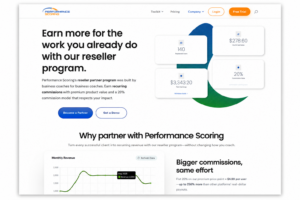
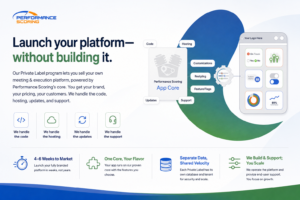
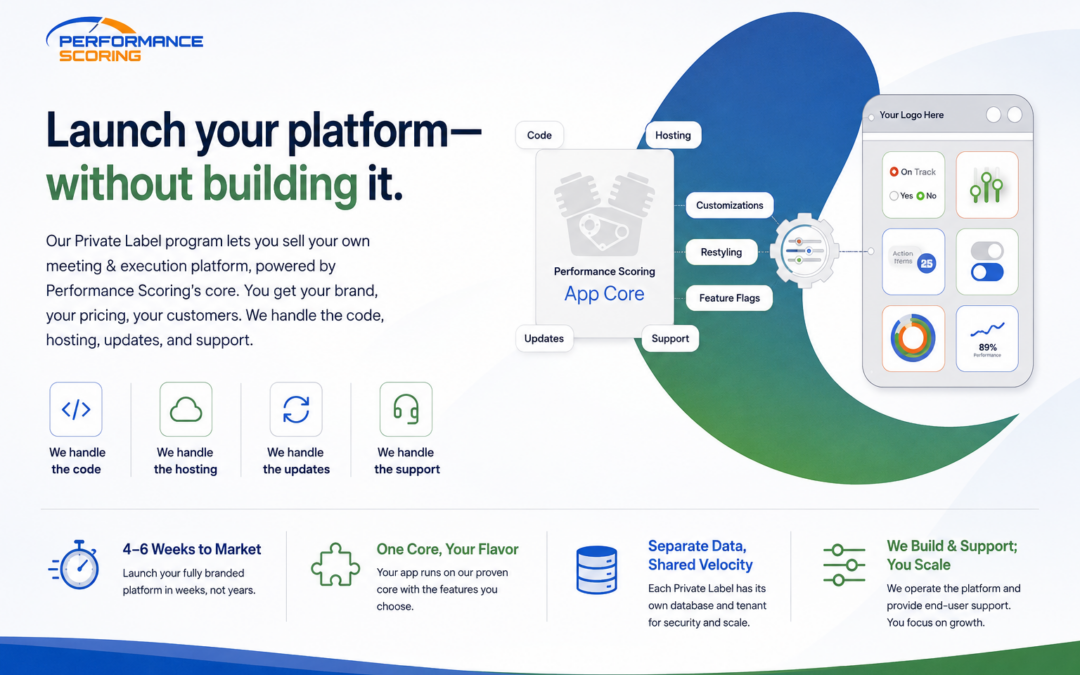
With Performance Scoring’s Private Label Partnership Program, businesses can launch their own branded meeting and execution platform without managing development, hosting, security, or software maintenance.
That means organizations can focus on growth while leveraging proven technology already built for scalability.
Why Private Label Partnerships Work
The reason private label partnerships are gaining momentum is simple:
They eliminate the biggest barriers that normally prevent businesses from launching software platforms.
Traditionally, building a software company required:
- Large development budgets
- Technical teams
- Ongoing software maintenance
- Security management
- Continuous updates
- Customer support infrastructure
For most organizations, that process was unrealistic.
Private label partnerships remove those obstacles by providing a ready-to-launch platform that businesses can customize with their own:
- Branding
- Pricing
- Methodology
- Customer experience
- Service model
This allows organizations to launch faster and scale more efficiently without years of development.
Every Industry Faces Similar Challenges
Although each industry operates differently, many organizations struggle with the same operational problems:
- Poor communication
- Lack of accountability
- Inconsistent meetings
- Limited visibility into projects and performance
- Disconnected teams
- Difficulty scaling operations
- Low client engagement
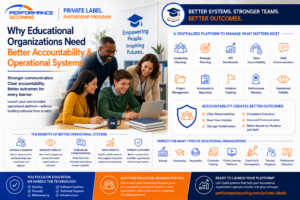
The industries we covered throughout this series all benefit from centralized systems that improve execution, communication, and operational visibility.
That’s why private label business platforms are becoming valuable across so many different sectors.
How Different Industries Benefit
Consultants can productize their frameworks into software that clients use daily, creating deeper relationships and scalable income.
Schools, training companies, and leadership programs can create branded learning and execution environments that improve engagement and accountability.
Business coaches and entrepreneurs can package their methodology into a scalable platform that creates monthly recurring revenue instead of relying solely on one-on-one services.
Financial & Professional Services
Accounting firms, financial advisors, legal teams, and business advisors can improve collaboration, communication, and operational visibility with clients and internal teams.
Healthcare consultants, wellness coaches, and medical organizations can streamline operations, meetings, compliance tracking, and accountability systems.
Marketing firms can offer branded client portals, campaign management systems, scorecards, and accountability tools that keep clients engaged long-term.
Organizations managing volunteers, projects, committees, and initiatives can improve alignment and execution with one centralized platform.
Operational accountability, safety meetings, project tracking, and performance visibility are critical in oil and gas. A customized platform can centralize communication and execution.
From HVAC to roofing to cleaning companies, service businesses need better team communication, task tracking, and operational consistency.
The Real Opportunity Is Ownership
One of the biggest advantages of private label partnerships is ownership.
Businesses maintain ownership of:
- Their brand
- Their customer relationships
- Their pricing structure
- Their methodology
- Their growth strategy
- Their recurring revenue
Performance Scoring powers the technology behind the scenes while partners focus on building their business and serving their customers.
That partnership creates a faster and more affordable path to launching a scalable platform business.
The Future Belongs to Scalable Systems
The business world is changing quickly.
Companies that thrive over the next decade will be the ones that create systems capable of scaling beyond individual services and hourly work.
Private label platforms allow businesses to:
- Generate predictable recurring revenue
- Improve customer retention
- Increase company valuation
- Differentiate themselves from competitors
- Expand their service offerings
- Build long-term operational ecosystems
And now, businesses can accomplish that without developing software from the ground up.
Build Something Bigger Than Services
This series highlighted one important reality:
Every industry has the opportunity to become a platform-driven business.
Whether you are a consultant, coach, educator, agency owner, nonprofit leader, healthcare organization, or operational business, the opportunity to create a scalable branded platform has never been more accessible.
The technology already exists.
The infrastructure is already built.
The opportunity is already here.
Ready to Launch Your Own Branded Platform?
If you’ve been thinking about creating a more scalable business model, now is the perfect time to explore a Private Label Partnership with Performance Scoring.
You bring the expertise.
We provide the platform.
Together, we can help you build something far bigger than software.
Visit our Private Label page to learn more then contact us to get started!

References and Further Reads:
Harvard Business School — Subscription Models: Recurring Revenues for Lasting Growth
Excellent authority source on why recurring revenue and subscription-based business models are reshaping modern companies.
Harvard Business School Article
Harvard Business Review — The Rebirth of Software as a Service
Strong strategic piece explaining why recurring customer relationships and ongoing engagement outperform traditional transactional models.
Harvard Business Review Article
Harvard Business School Online — Platform-Based Business Models
Useful reference supporting the idea that modern companies increasingly win by owning platforms, ecosystems, and scalable operating systems.
Harvard Business School Online
Gallup — Employee Engagement Research
Strong supporting research for the operational accountability, alignment, and execution side of your messaging. Gallup directly connects engagement to productivity, profitability, retention, and performance.
Gallup Employee Engagement Research
MIT Sloan Management Review — Business Model Innovation Research
Supports the broader concept that organizations must evolve beyond traditional service models and innovate around scalable systems and platforms.
MIT Sloan Management Review Research