Organizations invest millions of dollars each year in assessments, surveys, and evaluation tools designed to improve performance.
Yet many leaders find themselves asking the same question months later:
“Why hasn’t anything actually changed?”
The problem isn’t that assessments are ineffective.
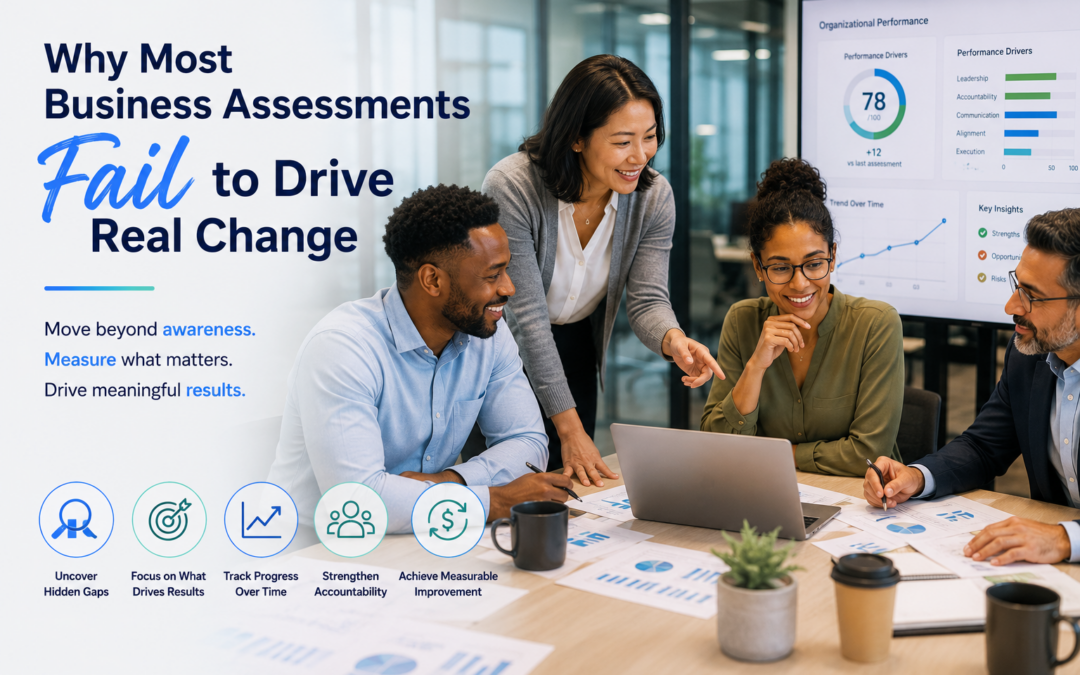
The problem is that many assessments stop at awareness.
They identify characteristics, behaviors, opinions, or perceptions, but they often fail to provide a clear path toward measurable improvement.
For organizations focused on growth, accountability, and execution, awareness alone isn’t enough.
The Difference Between Information and Action
Most assessment tools provide information.
They help organizations understand personalities, communication styles, employee sentiment, or workplace preferences.
That information can be valuable.
However, knowing how people think is very different from understanding how the organization is performing.
Leaders don’t just need insights about individuals. They need visibility into how teams are working together, how effectively strategies are being executed, and where performance gaps are preventing progress.
Without that visibility, even the best intentions can fail to produce meaningful results.
Why Organizations Struggle to Maintain Momentum
Many assessments generate excitement immediately after completion.
Reports are reviewed.
Meetings are held.
Action plans are discussed.
Then daily operations take over.
The assessment becomes another document stored in a folder, referenced occasionally but rarely used to drive ongoing improvement.
This happens because the assessment was designed as a one-time event rather than part of a continuous performance process.
Real organizational improvement requires more than a snapshot.
It requires measurement, accountability, and consistent evaluation over time.
What Leaders Really Need to Measure
Successful organizations focus on the factors that directly influence results.
These include:
- Leadership effectiveness
- Team alignment
- Accountability
- Communication
- Employee engagement
- Strategic execution
- Organizational trust
- Operational efficiency
When leaders can measure these areas consistently, they gain a clearer understanding of where improvement is needed and whether changes are producing results.
This transforms performance management from guesswork into a strategic advantage.
Moving Beyond Opinions and Assumptions
Every organization has blind spots.
Leadership teams often believe they understand the challenges facing their company, but employee experiences can tell a different story.
Without objective data, decisions are frequently influenced by assumptions, isolated incidents, or the loudest voices in the room.
Performance measurement helps eliminate uncertainty.
By gathering insights from across the organization, leaders can identify trends, uncover hidden challenges, and focus their efforts where they will have the greatest impact.
The result is better decision-making and stronger organizational alignment.
The Power of Continuous Performance Measurement
The most successful organizations don’t assess performance once.
They measure it consistently.
Continuous measurement allows leaders to:
- Establish benchmarks
- Track progress over time
- Identify emerging issues early
- Measure the impact of initiatives
- Improve accountability
- Strengthen organizational alignment
Most importantly, it creates a culture of continuous improvement rather than reactive problem-solving.
Organizations become more agile because they can identify challenges before they become major obstacles.
Turning Insights Into Results
Data by itself doesn’t create change.
Action does.
The value of performance measurement comes from the conversations, decisions, and accountability it creates.
When organizations have access to meaningful performance insights, they can move beyond assumptions and focus on what matters most.
Instead of asking, “How do people feel things are going?” leaders can ask, “What does the data tell us, and what should we do next?”
That shift is where real change begins.
The Future Belongs to Measurable Organizations
The organizations that thrive in today’s business environment are those that can adapt, improve, and execute consistently.
They don’t rely solely on intuition.
They use data to guide decisions, improve accountability, and strengthen performance at every level of the organization.
Assessments that create awareness are valuable.
Performance measurement that drives action is transformational.
The difference between the two is often the difference between knowing what needs to change and actually making it happen.
Ready to Help Clients Drive Real Change?
As a Performance Scoring reseller, you can provide organizations with more than insights—you can help them create measurable improvement.
Performance Scoring equips advisors, consultants, coaches, and business professionals with the tools to uncover performance gaps, strengthen accountability, and support continuous organizational growth.
Schedule a demo today to learn how Performance Scoring helps organizations move beyond awareness and achieve measurable results.
Sign up for your free 30-day trial today to see how Performance Scoring can help you deliver deeper insights, stronger client outcomes, and long-term growth for your advisory practice.
Check out our Resellers video below.
References and Further Reading
Help Your Team Choose Accountability
Harvard Business Review
https://hbr.org/tip/2026/05/help-your-team-choose-accountability
Optimize Your Team’s Performance
Harvard Business Review
https://hbr.org/tip/2024/09/optimize-your-teams-performance
Align Your Team Around a Common Vision of Success
Harvard Business Review
https://hbr.org/tip/2024/02/align-your-team-around-a-common-vision-of-success
How to Build Accountability for High Performance
Forbes
https://www.forbes.com/sites/harmoncullinan/2026/02/12/accountability-is-the-secret-sauce-for-performance-whats-the-recipe/
Performance
U.S. Small Business Administration
https://www.sba.gov/about-sba/organization/performance