Version 8 Is Here
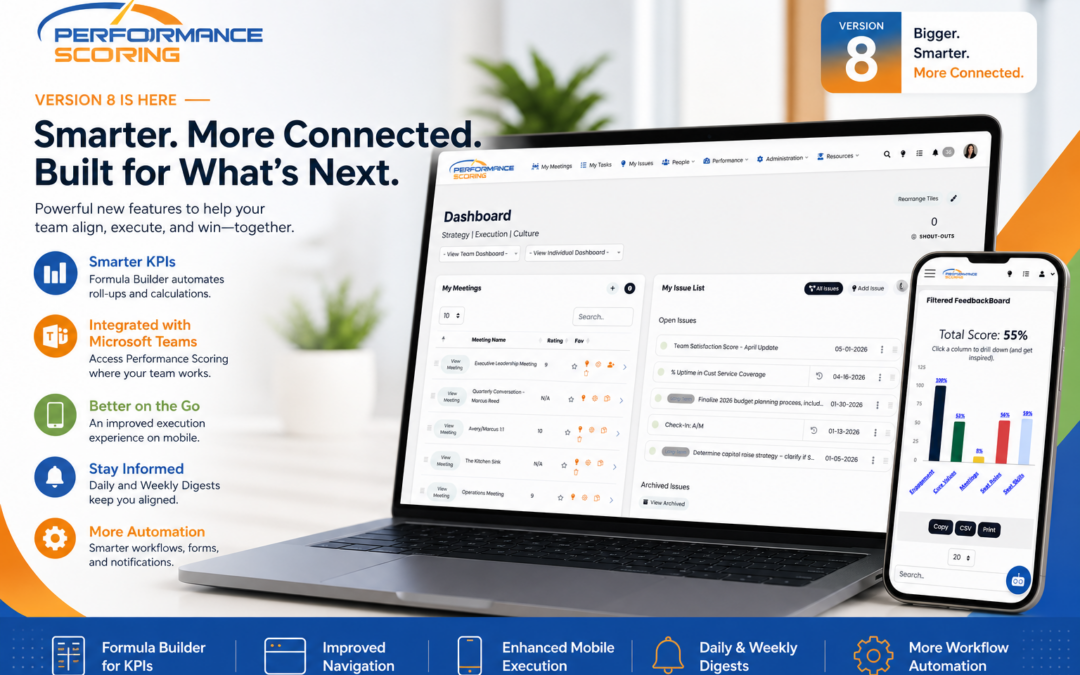
We’ve been hard at work building a faster, more flexible, and more connected experience across the Performance Scoring platform—and Version 8 is one of our biggest releases yet.
This release goes far beyond surface-level improvements. Version 8 gives leaders more control over how performance systems are structured, introduces powerful KPI automation, enhances the day-to-day experience across desktop and mobile, and brings Performance Scoring closer to the tools your team already uses.
Here’s what’s new.
More Control Over Core Values, Alignment, and Coaching
One of the biggest improvements in Version 8 is the ability to control the order of the items that matter most to your organization.
You can now customize the order of:
- Core Values
- Alignment / Engagement items
- Roles & Responsibilities
- Role Competencies
Previously, many of these were automatically sorted—often alphabetically. Now, you can arrange them in the exact sequence that reflects how your organization actually operates.
That order now carries through into:
- The Business Planner
- Reviews
- Coaching dashboards
- Individual performance views
This creates stronger alignment, greater consistency, and ensures the platform reflects your real priorities—not a default system structure.
Formula Builder for KPIs (Scorecards)
This is a major leap forward in performance management.
With Version 8, you can now build KPIs that automatically calculate values using formulas based on other KPIs.
That means you can:
- Roll up department KPIs into company-level scorecards
- Use operators like +, −, ×, ÷, and parentheses
- Automatically update metrics in real time
- Apply manual overrides when needed
This unlocks a smarter way to manage performance across your organization.
You can now create:
- True roll-up scorecards
- Automated company-level metrics
- Advanced KPI logic
- Smarter SMART goals with less manual reporting
Instead of updating numbers manually, Performance Scoring now does the work—while keeping you in control.
Performance Scoring Inside Microsoft Teams
Version 8 brings Performance Scoring directly into Microsoft Teams—where many teams already collaborate daily.
What this means:
- Easy access to Performance Scoring within Teams
- Seamless authentication and login
- Better continuity between communication and execution
- Less switching between tools
We’ve also expanded Teams-based notifications, helping keep your team aligned and informed in real time.
For organizations using Microsoft 365, this makes Performance Scoring feel like a natural part of your workflow—not a separate system.
A Better Execution Experience on Mobile
Managing priorities on the go is now easier than ever.
Version 8 includes major improvements to execution tools on mobile devices:
- Better responsiveness across screen sizes
- Easier interaction with tasks and priorities
- Cleaner layouts and improved usability
- Faster updates while working remotely
Whether your team is in meetings, in the field, or on the move, execution is now smoother and more practical.
A More Fluid “Giant Drawer” Navigation Experience
We’ve redesigned how users move through the platform.
Instead of opening endless tabs, Version 8 introduces a flexible “Giant Drawer” system that keeps users in context.
Users will notice:
- Expandable side panels (25%, 50%, 75%, 90%)
- Smoother transitions between views
- Fewer disruptive tab switches
- Option to open full-page views when needed
This creates a more modern, uninterrupted workflow across the platform.
More Workflow Automation and Smarter Notifications
Version 8 helps teams follow through more consistently by expanding automation and improving how information is delivered.
New features include:
- Scheduled forms
- Automated reminders
- Anonymous submissions
- Expanded notification options
Stay Aligned with Daily and Weekly Digests
Version 8 also introduces improved Daily and Weekly Digest notifications—making it easier to stay informed without chasing updates.
These digests provide a consolidated summary of what matters most, helping leaders and team members stay aligned, aware, and proactive without needing to log in constantly.
Digests can include updates across:
- KPIs and Scorecards
- Priorities and execution progress
- Coaching and feedback activity
- Forms and engagement
Users have full control over these notifications.
To customize or enable your digests:
- Go to your User Profile
- Select Notifications
- Turn on Daily Digest and/or Weekly Digest
- Choose the updates you want to receive
This ensures every user gets the right level of visibility—without unnecessary noise—so they can stay focused while remaining connected.
More Stability, Scalability, and Platform Maturity
Beyond new features, Version 8 includes major behind-the-scenes improvements:
- More reliable deployments and releases
- Enhanced backup and system readiness
- Stronger notification infrastructure
- Improved Microsoft Teams connectivity
- Greater UI consistency across environments
- Ongoing fixes and performance enhancements
This isn’t just a feature update—it’s a platform maturity upgrade.
Version 8 is designed to help organizations operate with more clarity and less friction.
With these updates, you can:
- Structure Core Values and coaching systems your way
- Automate KPI scorecards instead of managing them manually
- Work seamlessly inside Microsoft Teams
- Execute priorities efficiently from anywhere
- Stay aligned through smart digests and notifications
- Navigate the platform with speed and ease
Together, these improvements make Performance Scoring more intuitive, more powerful, and more aligned with how real teams operate.
Final Thoughts
Version 8 represents a major step forward in the evolution of Performance Scoring—bringing together deeper alignment, smarter automation, better usability, and tighter integration with real-world workflows.
It gives leaders more control, more visibility, and more momentum—so they can spend less time managing systems and more time driving results.
Further Reading
- What your KPIs are really measuring in performance management systems
https://hbr.org/2020/09/what-are-your-kpis-really-measuring - How to create KPIs that align with business strategy and goals
https://hbr.org/2020/02/create-kpis-that-reflect-your-strategic-priorities - How organizations execute strategy and turn goals into results
https://www.mckinsey.com/capabilities/people-and-organizational-performance/our-insights/the-organization-blog/execute-to-win-how-healthy-organizations-turn-vision-into-results - Improving strategic performance management for better business outcomes
https://www.gartner.com/en/articles/strategic-outcomes - Why performance management systems fail and how to fix them effectively
https://www.forbes.com/councils/forbescoachescouncil/2022/12/08/why-performance-management-systems-dont-work-and-how-to-fix-them/