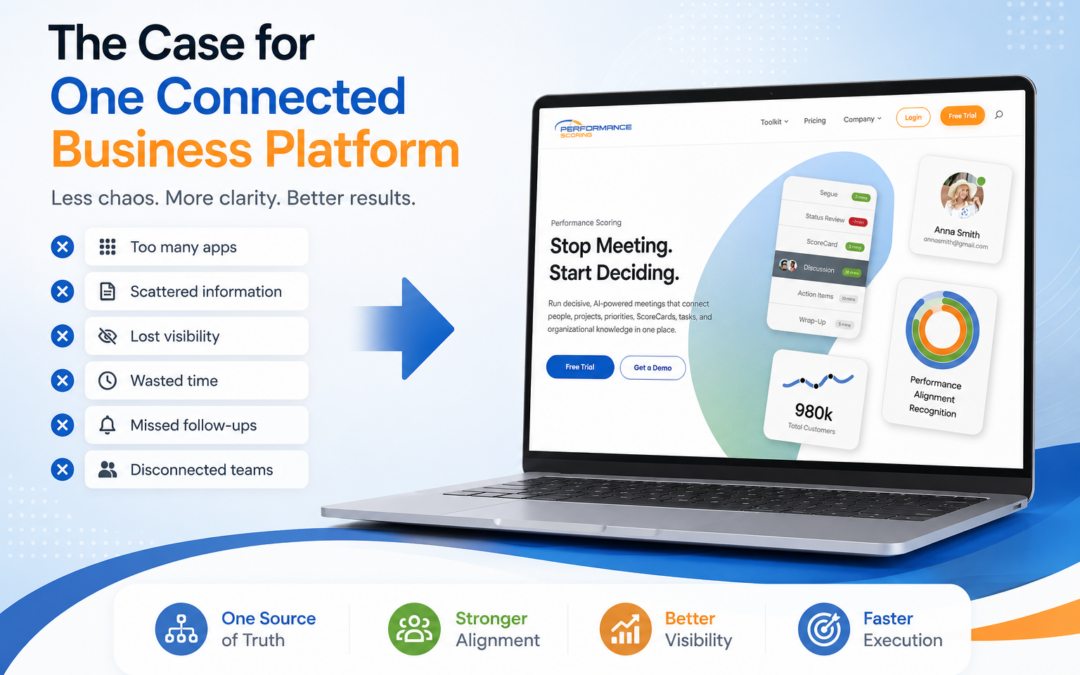
How many software applications does your business use every day?
CRM. Project management. Team chat. Meetings. Documents. Performance reviews. Dashboards. AI note takers. Task management. Surveys. Reporting. Calendars.
For many growing organizations, the answer is somewhere between 10 and 20.
At first, adding another app seems like the logical solution. Each promises to solve a specific problem, improve productivity, or make collaboration easier.
But over time, something unexpected happens.
The software meant to simplify your business begins making it more complicated.
More Apps Often Mean More Work
Every new application introduces another place to log in, another notification to check, another system to learn, and another source of truth.
Instead of spending time moving work forward, employees spend time switching between platforms.
A project starts in one application.
The discussion happens in another.
Meeting notes live somewhere else.
Tasks are tracked in a different system.
Performance metrics are stored in a spreadsheet.
Before long, no one knows where to find the latest information.
The result isn’t better organization.
It’s fragmented work.
The Hidden Cost of Context Switching
Research has shown that constantly switching between tasks and applications reduces focus and increases mistakes.
Every interruption forces your brain to stop, remember where you left off, and refocus on something new.
Multiply that by dozens of app switches every day, across every employee, and the cost becomes significant.
It’s not just lost minutes.
It’s lost momentum.
Visibility Is More Valuable Than More Software
Successful organizations don’t necessarily use the most software.
They use software that works together.
Leaders need one place where they can quickly answer questions like:
- What projects are on track?
- What tasks are overdue?
- Which teams need help?
- Are we hitting our goals?
- What happened in yesterday’s meeting?
- Who owns the next step?
When information is scattered across multiple systems, finding answers becomes slow and frustrating.
When it’s connected, leaders can spend less time searching and more time making decisions.
One Platform Creates Better Alignment
Imagine opening one platform and immediately seeing:
- Your business plan and strategic priorities
- Active projects and tasks
- Team and individual metrics
- Meeting agendas, notes, and action items
- Organizational structure
- AI-generated meeting summaries
- Dashboards that show progress across the business
Instead of asking employees to update multiple systems, everyone works from the same source of truth.
That creates better communication, stronger accountability, and faster execution; and it’s why we created Performance Scoring.
Technology Should Simplify Work
Software should remove complexity, not create it.
The goal isn’t to replace technology.
It’s to reduce the number of disconnected tools your team depends on every day.
When information lives in one connected platform, people spend less time managing software and more time doing meaningful work.
That’s when technology becomes a competitive advantage instead of another thing to manage.
Ready to Simplify the Way You Work?
If your business is juggling too many disconnected applications, it may be time for a different approach.
The Performance Scoring 30-Day Business Challenge gives you the opportunity to experience how one connected platform can help improve accountability, streamline communication, organize projects, track performance, and keep your entire organization aligned.
Take the challenge, simplify your workflows, and see what your team can accomplish when everyone is working from the same playbook.
References & Further Reading
- Harvard Business Review
Are Collaboration Tools Overwhelming Your Team?
https://hbr.org/2023/08/are-collaboration-tools-overwhelming-your-team - Harvard Business Review
Collaboration Overload Is Sinking Productivity
https://hbsp.harvard.edu/product/H06K3M-PDF-ENG - McKinsey & Company
Mapping the Value of Employee Collaboration
https://www.mckinsey.com/capabilities/people-and-organizational-performance/our-insights/mapping-the-value-of-employee-collaboration - Harvard Business Review
Digital Transformation
https://hbr.org/topic/subject/digital-transformation - Harvard Business School
Teams in the Digital Workplace: Technology’s Role for Communication and Collaboration
https://www.hbs.edu/faculty/Pages/item.aspx?num=64222