Most leaders know their business.
They know their people. They know their customers. They know the goals they’re working toward. And they usually have a pretty good sense of what’s going well and what needs attention.
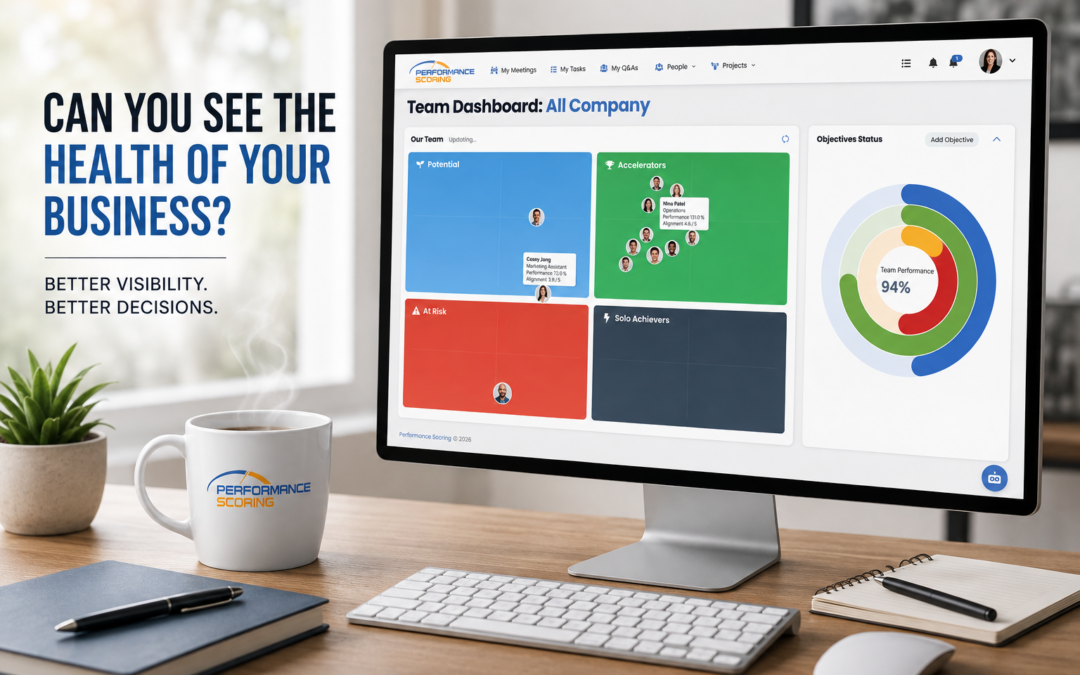
But there’s a difference between knowing your business and being able to clearly see the health of your business.
When someone asks, How is the business doing right now? how quickly can you answer?
Not just revenue. Not just whether the team is busy. The whole picture.
That’s where business visibility becomes important.
What Does Business Health Really Mean?
Business health isn’t represented by a single number.
A company can hit its revenue goal while important Projects are falling behind. A team can complete Tasks while key Metrics are moving in the wrong direction. Employees can appear productive while unclear responsibilities or performance issues are developing behind the scenes.
To understand business health, leaders need visibility across multiple areas, including:
- Business goals and priorities
- Projects and progress
- Tasks and accountability
- Key Metrics
- Meetings and follow-through
- Team structure
- Individual and team performance
Looking at these areas together provides a much different perspective than evaluating each one independently.
The Problem With Disconnected Business Information
For many organizations, the information leadership needs already exists.
The problem is where it exists.
Your Business Plan may be in one document. Metrics might live in a spreadsheet. Projects could be tracked in another system. Tasks may be scattered across email, meeting notes, and individual task lists.
Employee performance may live somewhere else entirely.
That means answering a simple leadership question can require gathering information from multiple places.
What’s off track right now?
That shouldn’t require a scavenger hunt.
When business information is disconnected, leaders can spend more time collecting information than actually using it.
Better Visibility Changes the Conversation
Imagine starting a leadership meeting with a clearer understanding of what’s happening before the conversation even begins.
You can see that a Metric has slipped.
A major Project isn’t progressing as expected.
Several Tasks are overdue.
A team member may need additional support.
Or maybe everything is moving exactly as planned.
Either way, leadership isn’t starting from assumptions.
You’re starting with visibility.
That changes the conversation from:
How do we think things are going?
to:
Here’s what we’re seeing. What should we do about it?
One Business. One Connected Picture.
This is one of the ideas behind Performance Scoring.
Instead of treating planning, execution, meetings, Metrics, Projects, Tasks, and people performance as completely separate parts of the business, Performance Scoring brings them together.
Your Business Plan establishes where you’re going.
Projects help move important priorities forward.
Tasks create individual accountability.
Metrics provide measurable indicators of progress.
Meetings create a place to discuss what’s happening and determine next steps.
People and performance insights help leaders understand the human side of execution.
Together, they create a much clearer picture of the organization.
Business Visibility Isn’t About Watching Everything
More visibility shouldn’t mean more micromanagement.
And it definitely shouldn’t mean staring at dashboards all day.
The purpose is to make it easier to identify what deserves your attention and what doesn’t.
If something is going well, great.
If something starts slipping, leadership has an opportunity to see it earlier.
If a Project stalls, you can ask why.
If a Metric changes unexpectedly, you can investigate.
If someone needs clarity, resources, or coaching, you can have that conversation.
Good business visibility helps leaders focus their attention where it can have the greatest impact.
What Could You See More Clearly?
Here’s a simple exercise.
Think about your business right now and ask yourself:
Could I quickly identify the three areas that need the most leadership attention this week?
If you can, that’s a great sign.
If answering that question requires checking several systems, asking multiple people for updates, searching through spreadsheets, or waiting until your next leadership meeting, there may be an opportunity to create better visibility.
And that’s exactly what we’re exploring throughout our September See Your Business More Clearly series.
Next, we’ll look at another important piece of business visibility:
Is your Business Plan actually connected to the work your team is doing?
Because having a plan is important.
Being able to see whether you’re executing it is even better.
Ready to See Your Business More Clearly?
Performance Scoring brings your Business Plan, Projects, Tasks, Metrics, Meetings, and people performance together so leadership can get a more connected view of the business.
Visit PerformanceScoring.com or email us at support@performancescoring.com to learn more or take the 30-Day Business Challenge and experience the platform with your own team.
References and further reads:
- McKinsey & Company – Organizational Health: A Fast Track to Performance Improvement
McKinsey article - Harvard Business Review – Making Your Strategy Work on the Frontline
Harvard Business Review article - MIT Center for Information Systems Research – Build Business Advantage With Real-Time Decision-Making
MIT CISR article