How long would it take you to answer this question:
How is the business doing right now?
Not how you think it’s doing.
Not how it performed last quarter.
Not what you heard in your last leadership meeting.
How is it actually doing right now?
Are your most important Metrics on track?
Are Projects moving forward?
Are Tasks getting completed?
Are employees performing against expectations?
Where is engagement slipping?
What needs leadership’s attention?
Are your company priorities actually turning into results?
For many leaders, answering those questions means going on an information hunt.
A spreadsheet here.
A Project management system there.
Meeting notes somewhere else.
An email from a manager.
A dashboard in another platform.
A conversation with HR.
And probably a few Slack or Teams messages asking:
Can you send me an update?
That’s not necessarily a lack of data.
It’s a lack of business visibility.
Leaders Usually Don’t Need More Information
Most businesses already have plenty of information.
The problem is that it’s scattered.
Sales has its system.
Operations has spreadsheets.
Projects are tracked somewhere else.
Employee performance lives with HR.
Meeting notes are stored in documents.
The Business Plan might be in a PDF nobody has opened in three months.
Individual managers may have their own tracking systems.
Each piece may be useful on its own.
But leadership still has to connect all of those pieces mentally to understand what’s actually happening across the business.
That’s where the problem begins.
More data doesn’t automatically create more clarity.
What Does Business Health Actually Mean?
Business health isn’t one number.
Revenue can be strong while employee engagement is declining.
Projects can be on schedule while important Metrics are slipping.
Employees can be incredibly busy while company priorities aren’t moving forward.
Sales can be growing while operational capacity is becoming a serious problem.
That’s why leadership needs to look at the business from multiple angles.
A clearer picture of business health might include:
- Company Metrics
- Project progress
- Task completion
- Employee performance
- Alignment
- Engagement
- Meeting activity
- Business Plan progress
- Organizational structure
- Leadership priorities
Each tells you something different.
Together, they tell you much more.
Start With the Business Plan
Earlier in this series, we started with the Business Plan for a reason.
It’s difficult to evaluate business health if you haven’t clearly defined where you’re trying to go.
Your Business Plan establishes direction.
What are we trying to accomplish?
Where are we going?
What are our priorities?
What needs to change?
What opportunities are we pursuing?
Once those things are clear, the rest of the organization can begin connecting back to them.
Your Business Plan shouldn’t be something leadership creates once a year and then stores away.
It should provide context for the decisions and work happening throughout the business.
Then Look at the Work
Strategy doesn’t create results by itself.
People have to execute it.
That’s where Projects, Tasks, and Metrics become important.
Projects show the larger priorities being worked on.
Tasks show the actions required to move them forward.
Metrics help determine whether the work is producing the expected results.
Now leadership can begin following a much clearer path:
What did we say we wanted to accomplish?
What are we doing about it?
Is the work moving?
Is it producing results?
That’s far more useful than simply knowing everyone is busy.
Then Look at the People
Businesses don’t execute strategies.
People do.
That’s why business health also requires visibility into the people responsible for the work.
Are responsibilities clear?
Do employees understand what success looks like?
Are they performing against expectations?
Do they have the right skills?
Are they engaged?
Are they aligned with the organization?
Where is coaching needed?
Where should great performance be recognized?
Where might the organization have a coverage or capacity problem?
Suddenly, employee performance isn’t separate from business performance.
It’s part of the same picture.
Meetings Connect the Pieces
Meetings are often where all of this information finally comes together.
Or at least, they’re supposed to be.
The problem is that many leadership meetings spend a significant amount of time simply collecting updates.
What’s happening with this Project?
Did that Task get completed?
Where are we on this Metric?
Has anyone talked to that employee?
What happened with that customer issue?
When information isn’t already visible, the meeting becomes an information-gathering exercise.
But imagine if leadership walked into the meeting already able to see what’s on track and what’s not.
Now the conversation can shift from:
What’s happening?
to:
What do we need to do about it?
That’s a much more valuable leadership meeting.
Look for Signals, Not Just Reports
One of the biggest opportunities with better business visibility is identifying signals earlier.
Leadership shouldn’t have to wait until something becomes a major problem before noticing it.
A Project moves off track.
A Metric begins trending downward.
Task completion starts slipping.
An employee’s performance changes.
Engagement declines.
A department begins struggling with capacity.
None of those signals automatically means something is seriously wrong.
But each may be worth understanding.
The earlier leaders can see a change, the earlier they can ask:
What’s happening here?
Sometimes the answer will be simple.
Sometimes it will reveal something that needs attention.
Either way, you’re finding out earlier.
Red Isn’t the Enemy
We’ve talked about this throughout the series because it’s an important mindset.
Leaders sometimes want dashboards filled with green.
Everything on track.
Everything completed.
Everyone performing.
It looks great.
But the purpose of visibility isn’t to make the business look healthy.
It’s to help you understand whether it is healthy.
If something is red, off track, or declining, that’s valuable information.
The problem isn’t the red indicator.
The problem is not knowing the issue exists.
Visibility allows leadership to identify areas needing attention before they become bigger problems.
Stop Building the Picture Manually
Think about how much leadership time is spent gathering information.
Managers prepare updates.
Someone builds a spreadsheet.
Someone else creates a report.
Departments send numbers.
Leaders ask follow-up questions.
Then someone combines everything into a presentation.
By the time the information reaches leadership, it may already be outdated.
Now imagine a different approach.
Instead of repeatedly building a picture of the business, the picture is continuously developing as the organization works.
Metrics update.
Projects progress.
Tasks get completed.
Meetings happen.
Employees receive feedback.
Performance Reviews are completed.
Check-Ins occur.
Company priorities move.
Leadership isn’t starting from zero every time it wants insight.
There’s already context.
From Business Data to Business Insights
Data tells you what happened.
Insights help you understand what deserves attention.
That’s an important difference.
Leadership doesn’t necessarily need to look at every Project, every Task, every employee, and every Metric every day.
They need a way to quickly identify:
What’s changing?
What’s off track?
What’s improving?
Where are we exposed?
What should we be talking about?
That’s where business visibility becomes useful.
The goal isn’t to give leaders more dashboards to stare at.
It’s to help them find the information that matters faster.
How Performance Scoring Creates a Connected View
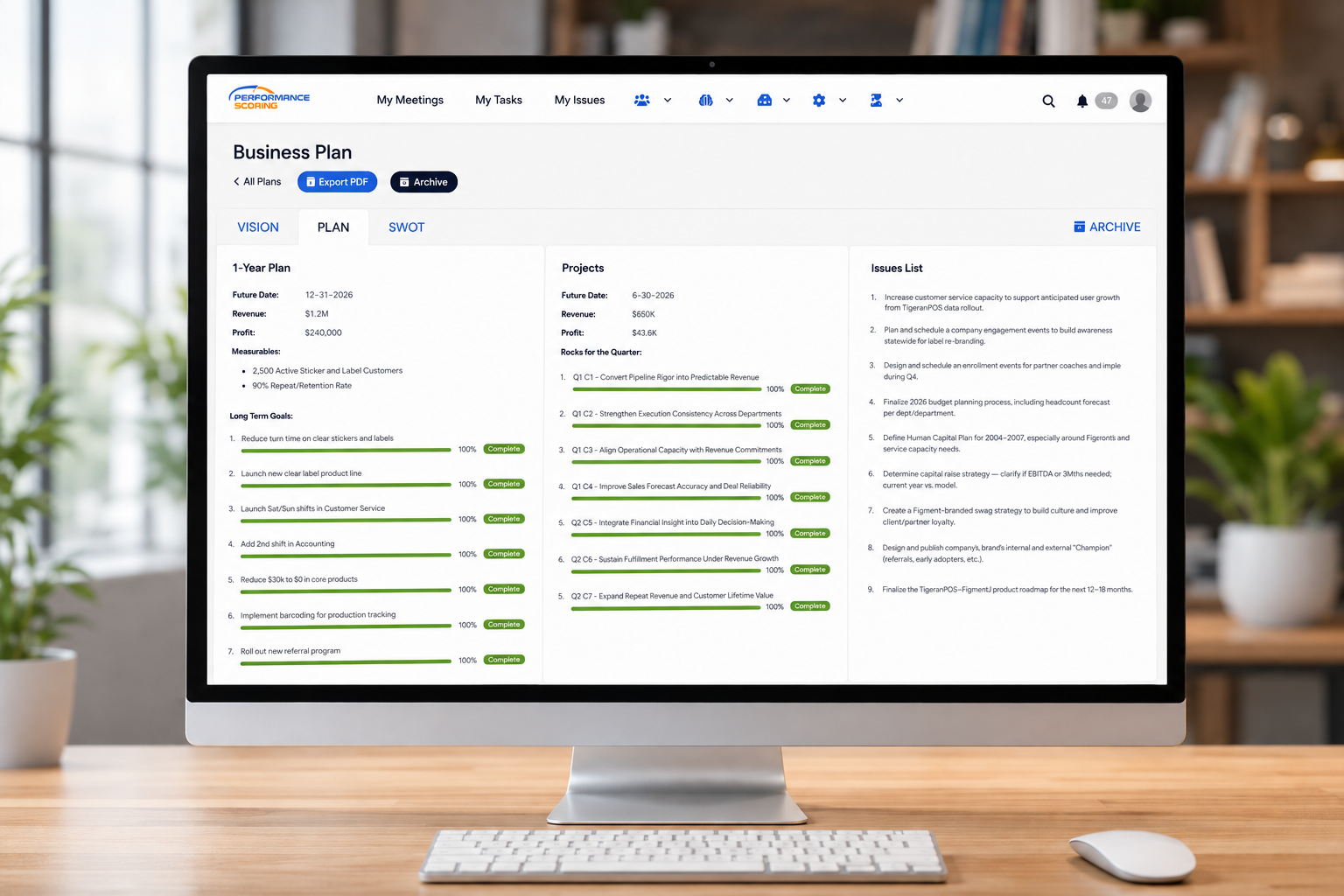
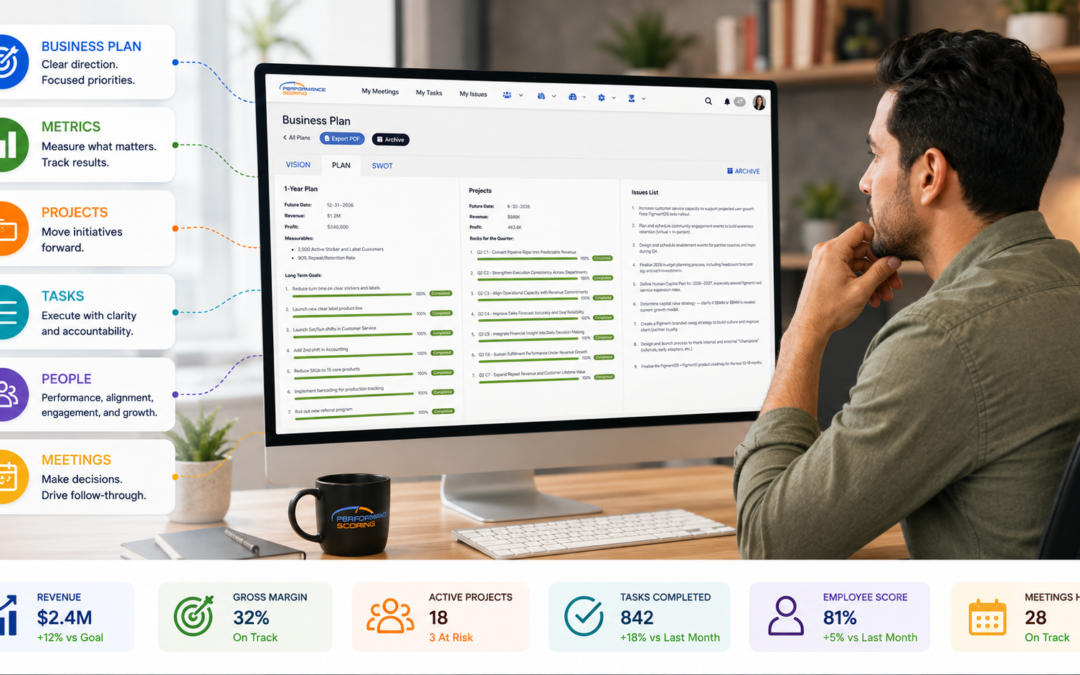
Performance Scoring brings many of the areas we’ve explored throughout this September series into one connected business environment.
Leaders can gain visibility across:
Business Plans for company direction and priorities.
Projects for larger strategic work.
Tasks for execution and accountability.
Metrics for measurable performance.
Meetings for decisions, discussion, and follow-through.
Org Charts for structure, responsibilities, skills, and people visibility.
Performance Reviews for structured employee evaluation.
Check-Ins and Coaching for ongoing development.
Feedback and High Fives for timely communication and recognition.
Performance, Alignment, and Engagement insights for additional visibility into your people.
Each tool serves a purpose.
But the real value comes from what happens when they’re connected.
Instead of seeing isolated pieces of the company, leadership begins seeing relationships between them.
Imagine Starting Monday Morning With the Bigger Picture
Instead of spending Monday morning asking managers for updates, imagine being able to quickly see:
Which Metrics need attention.
Which Projects have moved off track.
Where Tasks are overdue.
How teams are performing.
Where Alignment or Engagement may be changing.
What happened in recent Meetings.
Where leadership attention may be needed.
Then your leadership team can spend less time collecting information and more time deciding what to do with it.
That’s the shift.
From reporting to visibility.
From visibility to insight.
From insight to action.
Put Your Business Visibility to the Test
Here’s a simple challenge.
Without asking anyone for an update, opening multiple systems, or building a new report, try to answer these questions:
What are your five most important company priorities?
Which Projects support them?
Are those Projects on track?
Which Metrics are currently below goal?
Which Tasks are overdue?
Where is employee performance changing?
Where might engagement or alignment need attention?
What are the biggest issues leadership needs to discuss this week?
If answering those questions requires a scavenger hunt, your company probably doesn’t have an information problem.
You have a visibility problem.
See the Whole Business
This article kicks off Week 4: See the Whole Business in our September See Your Business More Clearly series.
During Week 1, we looked at the foundation of the business.
During Week 2, we followed the work through Meetings, Projects, Tasks, and Metrics.
During Week 3, we looked at the people responsible for making it happen.
Now we’re bringing those pieces together.
Because leadership shouldn’t have to look at strategy, execution, performance, and people as completely separate parts of the business.
They’re connected.
And the more clearly you can see those connections, the easier it becomes to understand what’s happening across the organization.
Next, we’ll explore:
What Would You Do With an Earlier Warning?
We’ll look at how trends, performance signals, and business insights can help leaders identify potential problems earlier, before they show up in the final results.
Ready to See the Whole Business More Clearly?
Performance Scoring connects your Business Plan, Projects, Tasks, Metrics, Meetings, Org Chart, employee performance, Alignment, Engagement, Reviews, Check-Ins, Coaching, and Feedback to give leadership a more connected view of the organization.
Less chasing down information.
More visibility into what deserves your attention.
Visit PerformanceScoring.com or email us at support@performancescoring.com to learn more or sign up today to take the 30-Day Business Challenge and experience the platform with your own team.
References and further reads:
- McKinsey & Company – Organizational Health: A Fast Track to Performance Improvement
McKinsey article - Harvard Business Review – Making Your Strategy Work on the Frontline
Harvard Business Review article - MIT Center for Information Systems Research – Build Business Advantage With Real-Time Decision-Making
MIT CISR article