Most leaders don’t have a shortage of information.
They have a shortage of time to find it.
The information they need is usually somewhere.
A Metric dashboard.
A Project update.
An overdue Task.
Meeting notes.
Employee performance data.
A Check-In.
An Issue that keeps coming up.
A Business Plan priority that hasn’t moved.
The challenge is pulling all of those pieces together and figuring out:
What actually deserves my attention?
But what if leadership didn’t always have to go looking?
What if the most important changes happening across the business were surfaced automatically and brought directly to you?
That could fundamentally change the way leaders use business data.
Leaders Shouldn’t Have to Hunt for Insight
Think about a typical Monday morning.
You want to understand how the business is doing.
So you start checking.
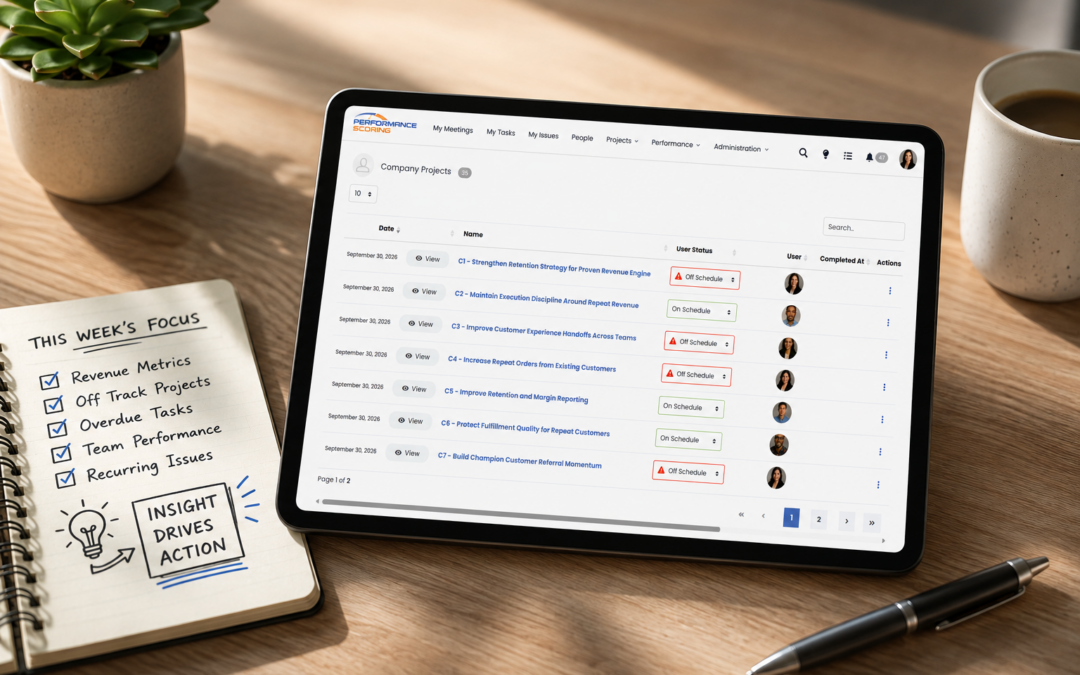
Which Metrics missed goal last week?
Which Projects moved Off Track?
Are important Tasks overdue?
What happened in last week’s Meetings?
Are there unresolved Issues?
How are teams performing?
Has employee Engagement changed?
Are company priorities moving?
You may be able to find every answer.
But how many places do you have to look?
And more importantly:
How much leadership time is spent finding information before you can actually do something with it?
Business visibility becomes much more valuable when leaders don’t have to continuously search for it.
A Dashboard Is Useful. An Insight Is Different.
Dashboards can be incredibly helpful.
They organize information.
They make trends easier to see.
They provide visibility into what’s happening.
But dashboards still require someone to open them and interpret what they’re seeing.
An insight goes one step further.
A dashboard might show:
Metric: 84%
An insight might tell you:
This Metric has missed goal for three consecutive weeks and declined 12% during that period.
A dashboard might show:
Project: Off Track
An insight might tell you:
This Project moved Off Track last week and has five overdue Tasks associated with it.
A dashboard gives you information.
An insight provides context around why that information may deserve your attention.
Imagine Starting the Week With a Leadership Brief
Instead of opening five different systems Monday morning, imagine receiving a concise summary of what changed across your business during the previous week.
Something like:
Metrics
3 company Metrics moved below goal.
Sales conversion declined for the third consecutive week.
Customer response time improved 14%.
Projects
2 Projects moved Off Track.
1 strategic Project returned On Track.
A Project connected to a top company priority has had no activity in two weeks.
Tasks
12 important Tasks became overdue.
Task completion improved 9% in Operations.
4 overdue Tasks are connected to the same Project.
People
Overall team performance remained steady.
Engagement declined in one department.
Two employees showed significant improvement in their Metrics.
Meetings & Issues
One Issue appeared in three separate Meetings.
Five Issues were resolved.
Two decisions created Tasks that are still incomplete.
Now leadership isn’t starting with:
Where should I look?
They’re starting with:
What should we do?
That’s a meaningful difference.
The Best Insights Include Wins Too
Business insights shouldn’t become a weekly list of everything that’s wrong.
That would quickly become exhausting.
Leaders also need to know what’s improving.
A Metric moved back above goal.
A Project was completed ahead of schedule.
Task completion improved.
An employee’s performance increased.
Engagement improved.
A recurring Issue was finally resolved.
A team hit an important milestone.
Those are meaningful business signals too.
Good leadership visibility should answer both:
What needs attention?
and
What’s working that we should recognize or continue?
Because business health isn’t just about identifying risk.
It’s also about recognizing momentum.
Context Makes Alerts More Useful
There’s a big difference between an alert and an insight.
An alert says:
Project Off Track.
An insight gives you context:
The Project moved Off Track this week. Three related Tasks are overdue, and the same capacity Issue has been discussed in the last two leadership Meetings.
Now leadership has a much better starting point.
The goal isn’t to bombard leaders with notifications every time something changes.
That would create another problem:
Too much noise.
The goal is to surface meaningful patterns.
Not Every Leader Needs the Same Information
The CEO may want a high-level view of the entire organization.
A department leader may care primarily about their team.
A manager may need visibility into employee performance and execution.
An Implementer or advisor may want insight across multiple client companies.
A reseller may want a high-level understanding of customer activity without needing to manage the customer’s day-to-day operations.
Different roles require different levels of visibility.
That’s why business insights become more valuable when they’re delivered with the right context.
The question isn’t simply:
What information do we have?
It’s:
What does this person need to know?
What If You Didn’t Even Have to Log In?
This is where the concept becomes especially interesting.
What if leadership could receive a weekly Business Insights Report directly in their inbox?
Not a massive spreadsheet.
Not a 40-page report.
Not every piece of data inside the platform.
A concise leadership summary highlighting meaningful changes across the organization.
Then, when something deserves closer attention, the leader could click through to see the details.
That changes the relationship between leadership and business software.
Instead of:
I need to remember to check the platform.
It becomes:
The platform is helping me know when I should look.
From Weekly Insights to Business Health
Weekly insights can help leaders understand what’s changing now.
But there is also value in occasionally stepping back and asking a bigger question:
How healthy is the business overall?
A quarterly Business Health Audit could look across a longer period of time.
Instead of focusing only on this week’s changes, leadership could examine broader patterns.
Are company Metrics improving quarter over quarter?
Are strategic Projects consistently being completed?
Are the same Issues resurfacing?
Is employee performance trending upward?
Is Engagement improving or declining?
Are company priorities actually turning into measurable results?
Are there organizational gaps creating risk?
That gives leadership two different perspectives.
Weekly Business Insights:
What’s changing right now?
Quarterly Business Health Audit:
What patterns are developing across the business?
Both can be valuable.
Business Insights Can Extend Beyond Internal Leadership
There’s another interesting opportunity when business information becomes easier to summarize.
The insights don’t necessarily have to stop with internal leadership.
Think about the people who help companies execute from outside the organization.
Consultants.
Coaches.
Fractional executives.
Implementers.
Integrators.
Advisors.
Resellers.
Depending on their relationship with the company, they may benefit from appropriate visibility into the businesses they support.
An advisor working with five companies shouldn’t necessarily have to log into five separate accounts every Monday just to understand where attention may be needed.
Instead, imagine receiving one consolidated summary with each client listed.
Company A: 3 items need attention
Company B: Performance stable
Company C: 2 Projects moved Off Track
Company D: Engagement improving
Company E: Recurring Issue detected
Click the company.
View the details.
Now business insights aren’t only helping company leaders.
They’re helping the people supporting those leaders become more proactive too.
White-Label Partners Could Bring the Same Value to Their Clients
The same concept could extend to organizations using a white-labeled version of a business platform.
Their clients receive insights under the partner’s brand.
The partner gains another way to provide ongoing value.
Instead of the software simply being a place customers log into, it becomes part of the partner’s ongoing relationship with the client.
That creates a powerful shift.
The technology isn’t just storing business information.
It’s helping surface conversations worth having.
The Goal Isn’t More Reporting
This is important.
Nobody needs another report just because software can generate one.
The value isn’t the email.
The value isn’t the dashboard.
The value isn’t the AI summary.
The value is helping someone answer:
What changed?
Why might it matter?
Where should I look?
What conversation should we have?
What action might we need to take?
If an insight doesn’t help leadership understand or act, it’s probably just more information.
AI Can Help Connect the Dots
As business platforms collect more connected information, AI creates an opportunity to help interpret it.
Not by making leadership decisions.
But by helping identify relationships that might otherwise be difficult to notice.
For example:
A Project moves Off Track.
Several associated Tasks are overdue.
A related Issue has appeared in multiple Meetings.
A Metric connected to the same initiative has declined.
Individually, those are four separate pieces of information.
Together, they may tell a much more important story.
AI can help surface those relationships.
Then leadership determines what they mean.
That’s an important distinction.
AI identifies the signal.
People provide the judgment.
From Information to Attention
Throughout this September series, we’ve talked a lot about visibility.
But visibility alone isn’t the final goal.
The real progression looks something like this:
Data → Visibility → Insight → Conversation → Action
Data tells you what happened.
Visibility makes it easier to see.
Insights help identify what deserves attention.
Conversations create understanding.
Action changes the outcome.
Technology can support every step.
But leadership still matters most at the end of that chain.
Put the Idea to the Test
Imagine you could receive one email every Monday morning containing the 10 most important things that changed in your business during the previous week.
What would you want included?
Your most important Metrics?
Projects that moved Off Track?
Overdue Tasks?
Employee performance changes?
Engagement trends?
Recurring Issues?
Progress against company priorities?
Major wins?
Areas of risk?
Then ask yourself:
How much time would that save me every week?
And perhaps more importantly:
What might I notice earlier that I’m currently missing?
That’s the opportunity.
See the Whole Business Without Searching for It
This continues Week 4: See the Whole Business in our September See Your Business More Clearly series.
We started this week by asking whether leadership can see the health of the business without chasing down information.
Then we explored the value of earlier warning signals.
Now we’re taking the next step:
Bring the insights to leadership.
Because the future of business visibility isn’t simply creating more dashboards.
It’s helping leaders spend less time searching for information and more time acting on what matters.
Next, we’ll close out our September series with:
What Changes When Your Whole Business Is Connected?
We’ll bring together everything we’ve covered throughout the month, from Business Plans and Meetings to Projects, Tasks, Metrics, people performance, and business insights, and look at what becomes possible when they stop operating as separate pieces.
What Would You Want to Know Every Monday Morning?
Performance Scoring is built around connecting the information leaders already use to run their businesses, including Business Plans, Metrics, Projects, Tasks, Meetings, Issues, Org Charts, Performance Reviews, Check-Ins, Coaching, Alignment, Engagement, and employee performance.
The opportunity is bigger than putting that information in one place.
It’s turning it into greater visibility and, ultimately, more useful business insights.
Visit PerformanceScoring.com or email us at support@performancescoring.com to learn more or take the 30-Day Business Challenge and experience the platform with your own team.
References and further reads:
MIT Center for Information Systems Research – Build Business Advantage With Real-Time Decision-Making
MIT CISR article
McKinsey & Company – Organizational Health: A Fast Track to Performance Improvement
McKinsey article
Harvard Business Review – Making Your Strategy Work on the Frontline
Harvard Business Review article