It’s easy to build a dashboard.
It’s harder to build one that actually tells you something useful.
Most businesses have no shortage of numbers available to them. Revenue, activity, completion rates, customer feedback, productivity, deadlines, utilization, safety, response times, quality scores, and dozens of other measurements can all end up competing for attention.
The problem usually isn’t a lack of data.
It’s knowing which numbers actually matter.
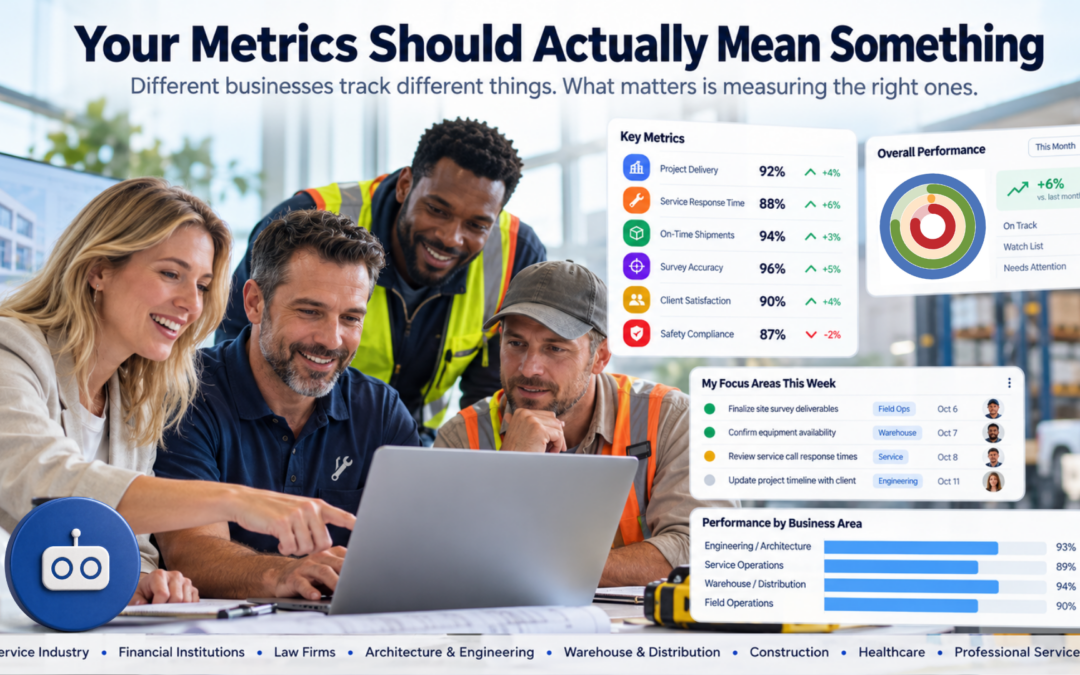
A useful performance system shouldn’t be filled with metrics simply because they can be measured. The goal is to identify the measurements that help leaders understand what is happening inside the business and decide what needs attention next.
More Data Does Not Always Mean More Visibility
There’s a difference between having information and having clarity.
A leadership team can have twenty dashboards, weekly reports, spreadsheets, and department scorecards and still struggle to answer some pretty basic questions:
Are we on track?
Where are we falling behind?
Which areas need attention?
Are our teams focused on the right things?
Are we improving?
That’s why adding more metrics isn’t always the answer.
Sometimes the better approach is reducing the number of things being measured and becoming more intentional about the ones that remain.
If a metric doesn’t help someone make a decision, identify a problem, or understand progress, it may not deserve the attention it’s getting.
The Right Metrics Depend on the Business
There is no universal performance scorecard that works for every organization.
What matters to a warehouse operation may have very little relevance to an architecture firm.
A warehouse or distribution team might closely monitor:
- Inventory accuracy
- Orders shipped on time
- Picking accuracy
- Safety incidents
- Receiving turnaround time
A professional services firm may care more about:
- Client retention
- Billable utilization
- Project profitability
- Deliverables completed on time
- Client satisfaction
A service business could be watching:
- Service calls completed
- First-time fix rate
- Customer response time
- Callbacks
- Maintenance agreement renewals
A financial institution may be paying attention to completely different measurements, such as branch performance, loan production, compliance, customer experience, or account growth.
Each organization is measuring performance.
But performance means something different in each one.
That distinction matters.
Start With the Question, Not the Number
One of the best ways to determine whether a metric belongs on a scorecard is to ask what question it is supposed to answer.
Instead of starting with:
“What can we measure?”
Start with:
“What do we need to know?”
If leadership wants to know whether projects are staying on schedule, the measurement might be milestone completion or projects delivered on time.
If the concern is customer experience, the right indicator could be response time, customer satisfaction, repeat business, or complaints.
If a team is struggling with execution, the useful measurement might be completed priorities or overdue tasks.
Starting with the business question makes it much easier to identify the right measurement.
Otherwise, it’s easy to end up tracking numbers simply because they’re available.
Not Every Metric Needs to Be Financial
Revenue and profitability obviously matter.
But financial results often tell you what already happened.
Operational metrics can help explain why it happened or give you an earlier indication of what may happen next.
A decrease in customer response time could eventually influence retention.
An increase in rework could affect profitability.
Missed project milestones could create future billing problems.
A decline in employee training completion could eventually show up in quality or customer experience.
That’s why the most useful scorecards often include a combination of results and activities.
You want to know the outcome.
But you also want visibility into the behaviors and processes influencing that outcome.
Team Metrics and Individual Metrics Serve Different Purposes
Another important distinction is deciding who actually owns the number.
Some measurements should belong to an individual.
Others should belong to a team.
For example, an individual sales representative may have a personal activity or production goal.
But customer satisfaction might reflect the work of several departments.
A warehouse manager may be accountable for overall shipping performance, but that doesn’t necessarily mean every employee should have an individual version of the same metric.
Trying to assign every number to every person can make accountability less clear, not more.
A better question is:
Who can actually influence this result?
That helps determine whether a metric should sit with an individual, a team, a department, or leadership.
A Scorecard Should Create Conversation
Metrics are most useful when they lead to better conversations.
A number turning red isn’t the problem.
In many ways, that’s exactly what the scorecard is supposed to reveal.
It creates an opportunity to ask:
What changed?
Is this a one-time issue or a pattern?
Do we understand the cause?
Does someone need help?
Do we need to change the process?
Is the target still realistic?
Without that visibility, problems can stay hidden much longer.
The goal isn’t to create a dashboard where everything is always green.
The goal is to make it easier to see reality.
Targets Should Be Useful, Not Arbitrary
A metric becomes much more valuable when everyone understands what good performance actually looks like.
But targets should have some reasoning behind them.
Setting every metric at 100% may look ambitious, but it isn’t always realistic or useful.
Some targets should be based on historical performance.
Others may come from industry benchmarks, customer expectations, capacity, service-level commitments, or strategic goals.
And sometimes a target needs to change.
If the business grows, the market changes, or the process improves, yesterday’s target may no longer make sense.
Metrics should create consistency without becoming permanent just because someone entered a number six months ago.
Keep It Simple Enough to Use
One of the easiest ways to make a performance system ineffective is to make it too complicated.
If managers need thirty minutes every week just to update their numbers, eventually the updates stop happening.
If leadership has to dig through several screens to understand performance, the information becomes less useful.
If employees don’t understand what a metric means or how it’s calculated, it’s unlikely to influence behavior.
The best performance measurements are usually easy to understand.
People know what is being measured.
They know why it matters.
They know who owns it.
And they can quickly see whether things are moving in the right direction.
Build the Scorecard Around the Business
The purpose of a scorecard isn’t to make every organization measure the same things.
It’s to make the important things easier to see.
That might mean five metrics for one team and fifteen for another.
It might mean financial measurements, operational measurements, employee performance, customer experience, project delivery, or a combination of all of them.
What matters is that the scorecard reflects the reality of the organization using it.
Because the most impressive dashboard in the world isn’t very helpful if the numbers on it don’t help you run the business.
Measure what matters. Make it visible. Then use it to make better decisions.
Learn more or start your free trial at PerformanceScoring.com.
References & Additional Reading
- Harvard Business Review — “The Balanced Scorecard: Measures That Drive Performance”
Robert S. Kaplan and David P. Norton’s classic work on balancing financial measures with customer, operational, and organizational performance measures. It strongly supports the article’s point that businesses need a focused set of measures that reflect what actually drives performance. Harvard Business Review
Read at Harvard Business Review - McKinsey & Company — “Gauging Internal Efficiency and Effectiveness With Leading and Lagging Indicators”
A particularly good match for your section on measuring outcomes versus the activities that influence them. McKinsey also recommends keeping the number of true KPIs limited and ensuring they are actionable, relevant, and aligned with strategic objectives. McKinsey & Company
Read at McKinsey & Company - Strategy& / PwC — “Strategic Performance Measurement: Creating a Common Language to Drive Execution”
Explores how organizations can connect strategy to everyday operations through a smaller set of meaningful performance measures rather than overwhelming teams with data. PwC
Read at Strategy& - Boston Consulting Group — “The Art of Performance Management”
BCG argues that strong performance-management systems focus on relevant KPIs rather than measuring everything available, with metrics tied directly to business strategy and decision-making. BCG Global
Read at Boston Consulting Group - MIT Sloan Management Review — “Strategic Measurement for High Performance”
A collection focused on KPIs, strategic execution, performance management, and how organizations can become more intentional about what they measure. MIT Sloan Management Review
Explore at MIT Sloan Management Review