Every organization has a strategy. Fewer have consistent execution.
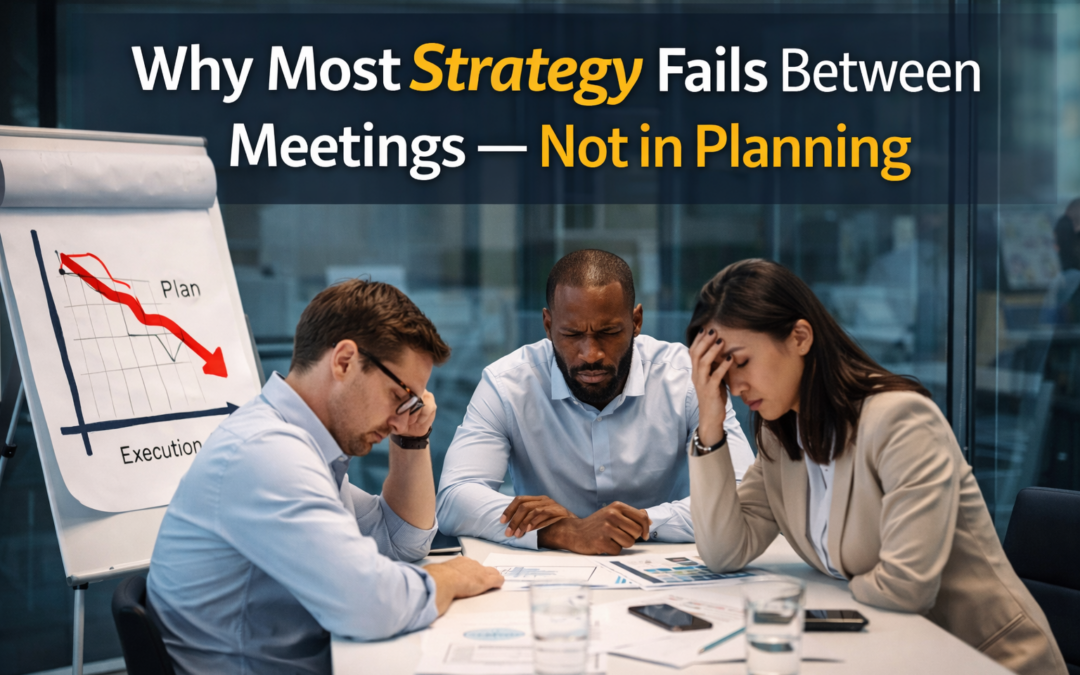
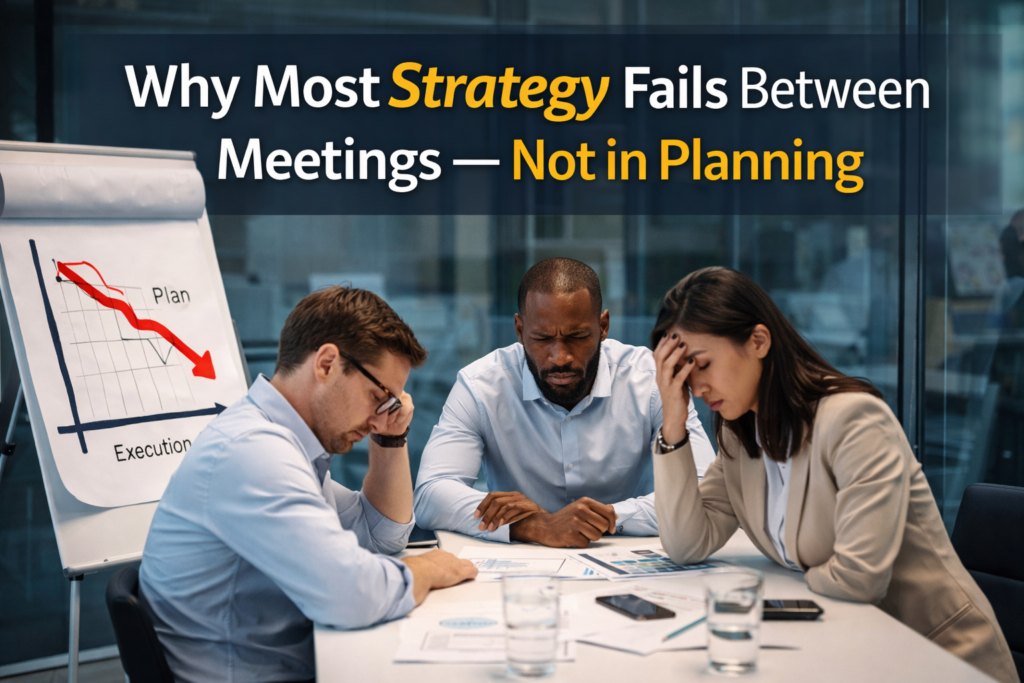
The problem usually isn’t the annual planning session, the offsite deck, or the leadership retreat. Strategy most often breaks between meetings, where decisions fade, accountability blurs, and momentum quietly stalls.
This is what we call strategy leakage. McKinsey refers to this challenge as the strategy-to-execution gap, where organizations lose momentum not because of bad plans, but because execution lacks structure and reinforcement.
Strategy Doesn’t Fail on Paper — It Fails in the Gaps
Research from Harvard Business Review shows that strategy execution often unravels after planning, when priorities compete, meetings drift, and no system connects strategy to daily execution.
Without a clear operating rhythm, strategy becomes a document—not a discipline.
That’s why meeting cadence becomes the real operating system of the organization. As MIT Sloan Management Review highlights, meetings that actually drive results are the primary mechanism for translating strategy into action, reviewing performance against reality, and course-correcting in real time.
When meetings lack structure, data, and follow-through, strategy decays.
The Real Execution Chain
High-performing organizations don’t treat strategy as an annual event. They run it through a continuous loop:
Strategy → Meetings → Action → Measurement
This loop only works when meetings are more than status updates. Inside effective meeting management, teams align goals, review performance data, assign ownership, and reinforce priorities consistently.
When meetings connect directly to performance management and goals & KPI tracking, strategy stops being theoretical. It becomes visible, measurable, and coachable.
Where Alignment Actually Breaks
Alignment doesn’t disappear all at once. It erodes quietly when:
- Action items aren’t owned or tracked
- KPIs aren’t reviewed in context
- Feedback happens too late (or not at all)
- Meetings operate separately from real performance data
That’s why organizations that integrate project & task management directly into meetings outperform those that rely on disconnected tools.
When tasks, commitments, and results are reviewed together, accountability becomes natural—not forced.
Meetings as the Execution Engine
The strongest teams use meetings to:
- Reinforce priorities through feedback and reviews
- Identify performance gaps early
- Coach in real time
- Recognize progress and momentum
This is where employee engagement actually grows—when people see how their work connects to strategy, week after week.
Strategy doesn’t need more planning. It needs a better execution system.
If your meetings aren’t driving action, measurement, and alignment, your strategy isn’t failing—it’s leaking.
👉 See how Performance Scoring turns meetings into the system that connects strategy to execution:
https://performancescoring.com/application/meeting-management/