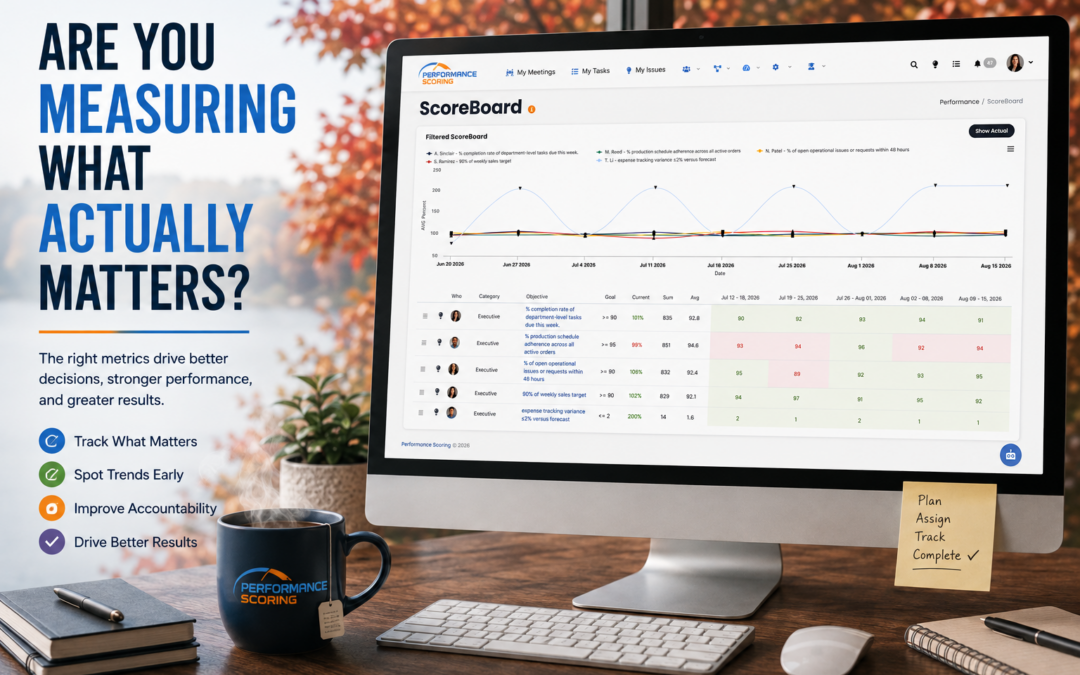
Most businesses track numbers.
Revenue. Sales. Leads. Expenses. Customer retention. Productivity. Project completion. Employee performance.
There is no shortage of data available to leaders today.
But having more numbers doesn’t necessarily create more clarity.
The better question is:
Are you measuring the things that actually tell you how your business is performing?
The right business metrics can give leaders an early indication of what’s working, what’s changing, and where attention may be needed.
The wrong ones can create a lot of reporting without providing much insight at all.
Metrics Should Help You Make Decisions
A Metric shouldn’t exist simply because it’s easy to measure.
It should tell you something useful.
Good Metrics help leadership answer questions like:
- Are we moving toward our goals?
- Is performance improving or declining?
- Where are we starting to fall behind?
- Is a process working the way we expected?
- Does someone need additional support?
- Are our Projects producing the results we wanted?
- Where should leadership focus its attention?
If a number doesn’t help you understand the business or make a better decision, it may be worth asking why you’re tracking it.
Don’t Wait for the Final Result
Some of the most important business numbers are lagging indicators.
Revenue is a great example.
Revenue tells you what already happened.
That’s obviously important, but if revenue starts declining, the behaviors or conditions that caused the decline may have started weeks or months earlier.
That’s why leaders also need leading indicators.
Imagine a sales team.
Revenue may be the ultimate result, but you might also track:
New opportunities → Proposals → Close rate → Revenue
If new opportunities begin declining today, revenue may still look perfectly healthy.
But the leading Metric gives leadership an earlier signal that something may need attention.
That’s the value of visibility.
You don’t have to wait for the final result to discover a problem.
What Does On Track Actually Mean?
A Metric becomes much more useful when there’s a clear expectation attached to it.
Instead of simply tracking:
Customer calls: 17
you might establish:
Weekly goal: 20 customer calls
Now leadership has context.
Seventeen isn’t just a number.
It’s a signal.
The same idea applies across the business.
If your customer retention goal is 95%, you can see whether you’re meeting it.
If your response-time target is under two hours, you can monitor whether performance is slipping.
If your sales team has a weekly pipeline goal, you can see whether activity is supporting future revenue.
The goal creates a reference point.
The actual result tells you what happened.
Together, they create insight.
Red Doesn’t Automatically Mean Poor Performance
One of the interesting things about making Metrics visible is that people sometimes become uncomfortable when something turns red.
But an off-track Metric isn’t automatically bad news.
It’s information.
Maybe an employee was on vacation.
Maybe there was a seasonal change.
Maybe a major customer delayed a purchase.
Maybe the goal itself needs to be reconsidered.
Or maybe something really is beginning to slip.
The Metric doesn’t necessarily tell you why something happened.
It tells you where to start asking questions.
That’s an important distinction.
Metrics should help create better conversations, not replace them.
Connect Metrics to People
Company-level Metrics are important, but visibility becomes even more valuable when leaders can understand how performance connects throughout the organization.
Different teams and people contribute to business results in different ways.
Sales may track pipeline and close rates.
Customer service may track response times and customer satisfaction.
Operations may track turnaround time or capacity.
Marketing may track qualified leads.
Finance may track margins or cash flow.
The goal isn’t to measure every activity an employee performs.
It’s to identify the handful of numbers that provide meaningful insight into whether a team, role, or business function is performing as expected.
That creates clearer expectations for employees and better visibility for managers.
Connect Metrics to Your Projects
Metrics also help answer an important question about your Projects:
Did the work actually make a difference?
Imagine your company launches a Project designed to improve customer onboarding.
The Project gets completed on time.
Great.
But did onboarding actually improve?
You might measure:
Customer onboarding time.
Customer satisfaction.
Support requests during the first 30 days.
Customer retention.
Now you’re not only measuring whether the Project was completed.
You’re measuring whether it produced the intended result.
That’s a much stronger connection between execution and performance.
Bring Metrics Into Your Meetings
Metrics become even more useful when they’re part of the regular rhythm of the business.
Instead of waiting for a monthly or quarterly report, your leadership team can review key Metrics during recurring meetings.
What’s on track?
What’s off track?
What changed?
What needs discussion?
If everything looks good, you can move on.
If something is slipping, leadership can dig deeper.
That keeps the conversation focused.
Rather than reviewing every number in detail, your team can concentrate on the Metrics that are signaling a potential issue or opportunity.
Don’t Measure Everything
Greater visibility doesn’t mean tracking hundreds of Metrics.
In fact, too many numbers can create the opposite effect.
When everything is important, nothing stands out.
The goal is to identify the Metrics that give you the clearest view of performance.
Ask:
What do we really need to know to understand whether this part of the business is healthy?
For some teams, that may be five numbers.
For others, it may be ten.
The number matters less than whether the Metrics are meaningful, measurable, and connected to something the organization is trying to accomplish.
How Performance Scoring Connects the Numbers
Performance Scoring helps bring your Metrics into the same environment as the rest of the work happening across your business.
Instead of your numbers sitting in a spreadsheet disconnected from everything else, Metrics can become part of a larger performance picture.
You can connect visibility across:
Metrics to measure performance.
Projects to track strategic work.
Tasks to create action and accountability.
Meetings to discuss what’s changing and determine next steps.
People performance to better understand individual and team results.
Business Plans to keep execution connected to company priorities.
That gives leadership more than a collection of numbers.
It creates business performance visibility.
Put Your Metrics to the Test
Take a look at the Metrics your leadership team currently tracks.
Then ask:
If one of these numbers changed significantly tomorrow, would we know what to do with that information?
Does each Metric have a clear goal?
Does someone own it?
Do you know how frequently it should be measured?
Does it connect to a business priority?
Would an off-track result create a meaningful conversation?
And perhaps most importantly:
Are we measuring what matters, or simply measuring what’s easy?
The best Metrics aren’t necessarily the most complicated.
They’re the ones that help you see what’s happening early enough to do something about it.
See the Work More Clearly
This concludes Week 2: See the Work in our September See Your Business More Clearly series.
We’ve explored how Meetings turn conversations into action, how Projects and Tasks help move priorities forward, and now how Metrics provide measurable visibility into whether that work is producing results.
Next, we’re moving into Week 3: See the People.
We’ll start with a question every leadership team should consider:
Does Your Org Chart Tell You More Than Who Reports to Whom?
Because understanding your organizational structure is useful.
Understanding the people, responsibilities, and performance behind that structure can tell you much more.
Ready to Measure What Matters?
Performance Scoring brings your Metrics, Projects, Tasks, Meetings, Business Plan, and people performance together so leaders can see what’s on track, identify changes earlier, and have better conversations about what happens next.
Visit PerformanceScoring.com or email us at support@performancescoring.com to learn more or take the 30-Day Business Challenge and experience the platform with your own team.
References and further reads:
- McKinsey & Company – Organizational Health: A Fast Track to Performance Improvement
McKinsey article - Harvard Business Review – Making Your Strategy Work on the Frontline
Harvard Business Review article - MIT Center for Information Systems Research – Build Business Advantage With Real-Time Decision-Making
MIT CISR article