Every business wants to grow.
More customers.
Higher revenue.
Stronger teams.
Better execution.
But growth doesn’t happen by accident.
If it did, every busy company would become a successful one.
Instead, the businesses that consistently outperform their competitors have something in common.
They don’t leave execution to chance.
Growth Isn’t About Working Harder
When a company starts growing, complexity grows with it.
More employees.
More customers.
More meetings.
More projects.
More decisions.
More moving parts.
Without a system to keep everything connected, growth can quickly become chaos.
Teams become disconnected.
Departments begin working toward different priorities.
Leaders spend more time putting out fires than planning for the future.
Growth should create momentum, not confusion.
Alignment Is the Competitive Advantage
Ask five people in the same company what the top three priorities are.
Would you get the same answer?
In many organizations, the answer is no.
When priorities aren’t clear, people naturally focus on what feels urgent instead of what’s most important.
That’s why alignment matters.
When every employee understands the company’s goals, knows how their work contributes, and can see progress being made, execution becomes faster and decisions become easier.
Alignment isn’t just good for culture.
It’s good for business.
The Best Leaders Create Visibility
High-performing organizations don’t rely on assumptions.
They rely on visibility.
Leaders know:
- Which goals are on track.
- Which projects need attention.
- Where accountability is slipping.
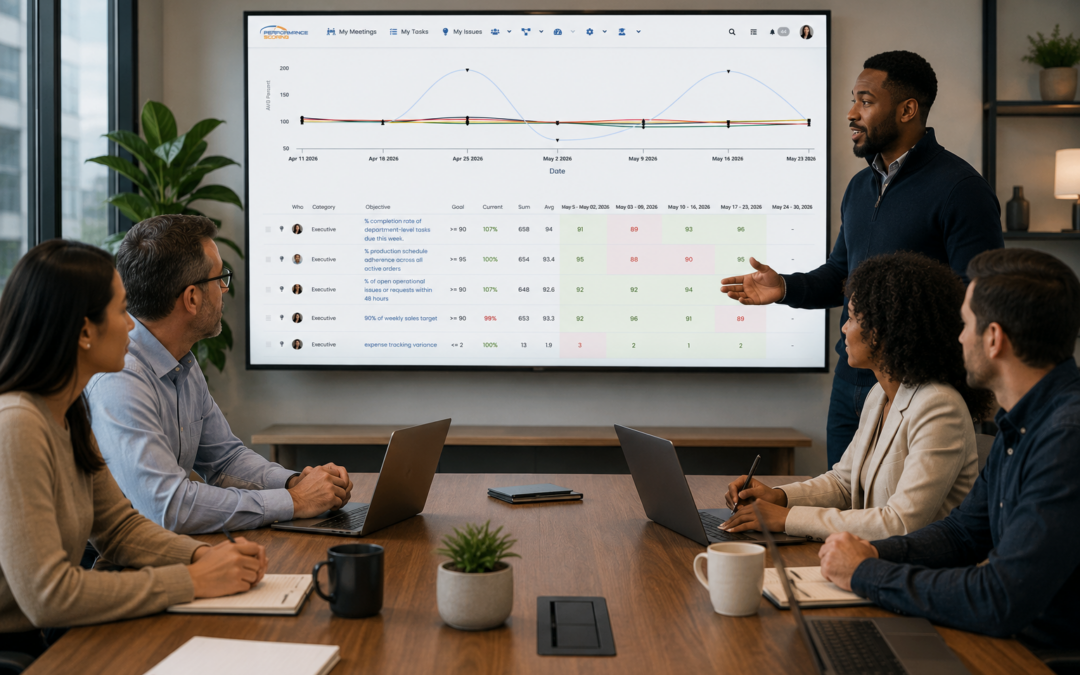
- How teams are performing.
- Which metrics need immediate action.
When information is visible, problems are discovered earlier.
Opportunities are identified faster.
Decisions become more confident.
AI Is Helping Leaders Focus on Leadership
Today’s leaders have access to more information than ever before.
The challenge isn’t finding data.
It’s turning data into action.
AI can summarize meetings.
Capture important discussions.
Generate tasks.
Surface insights.
Reduce administrative work.
Instead of spending hours organizing information, leaders can spend their time coaching people, solving problems, and moving the business forward.
Technology should remove friction, not create it.
One Platform. One Direction.
Many organizations use separate systems for meetings, planning, projects, tasks, metrics, and reporting.
Each tool solves one problem.
Very few connect everything together.
When business planning, goals, projects, tasks, meetings, AI, and performance insights work together in one place, something powerful happens.
Everyone works from the same information.
Everyone understands the priorities.
Everyone knows what success looks like.
That’s how organizations create consistency instead of confusion.
Great Businesses Don’t Just Measure Results
They measure progress.
Every completed task.
Every finished project.
Every meeting.
Every metric.
Every improvement.
Small wins create momentum.
Momentum creates consistency.
Consistency creates long-term growth.
The companies growing the fastest aren’t simply doing more.
They’re making sure everything they do moves in the same direction.
Ready to Build a More Aligned Business?
If your business is growing, now is the time to build the systems that support long-term success.
The Performance Scoring 30-Day Business Challenge gives you the opportunity to experience how connected business planning, projects, tasks, meetings, metrics, AI-powered insights, and organizational accountability help teams execute with confidence.
You’ll gain greater visibility, improve alignment, and create the momentum needed to finish this year strong and prepare for even greater growth next year.
Take the free 30-Day Business Challenge today and discover how every meeting can become a catalyst for real business results.
References & Further Reading
- Harvard Business Review
Are Collaboration Tools Overwhelming Your Team?
https://hbr.org/2023/08/are-collaboration-tools-overwhelming-your-team - Harvard Business Review
Collaboration Overload Is Sinking Productivity
https://hbsp.harvard.edu/product/H06K3M-PDF-ENG - McKinsey & Company
Mapping the Value of Employee Collaboration
https://www.mckinsey.com/capabilities/people-and-organizational-performance/our-insights/mapping-the-value-of-employee-collaboration - Harvard Business Review
Digital Transformation
https://hbr.org/topic/subject/digital-transformation - Harvard Business School
Teams in the Digital Workplace: Technology’s Role for Communication and Collaboration
https://www.hbs.edu/faculty/Pages/item.aspx?num=64222