Over the past month, we’ve asked a lot of questions.
Can your team see where the business is going?
Do your Meetings actually move work forward?
Can you tell what’s On Track and what’s Off Track?
Do your employees know what success looks like?
Can leadership see the health of the business without chasing down information?
Can you spot problems before they become bigger problems?
And most recently:
What if the business insights you need came directly to you?
Each question focused on a different part of running a business.
But there’s one final question that brings the entire September series together:
What changes when all of those pieces are connected?
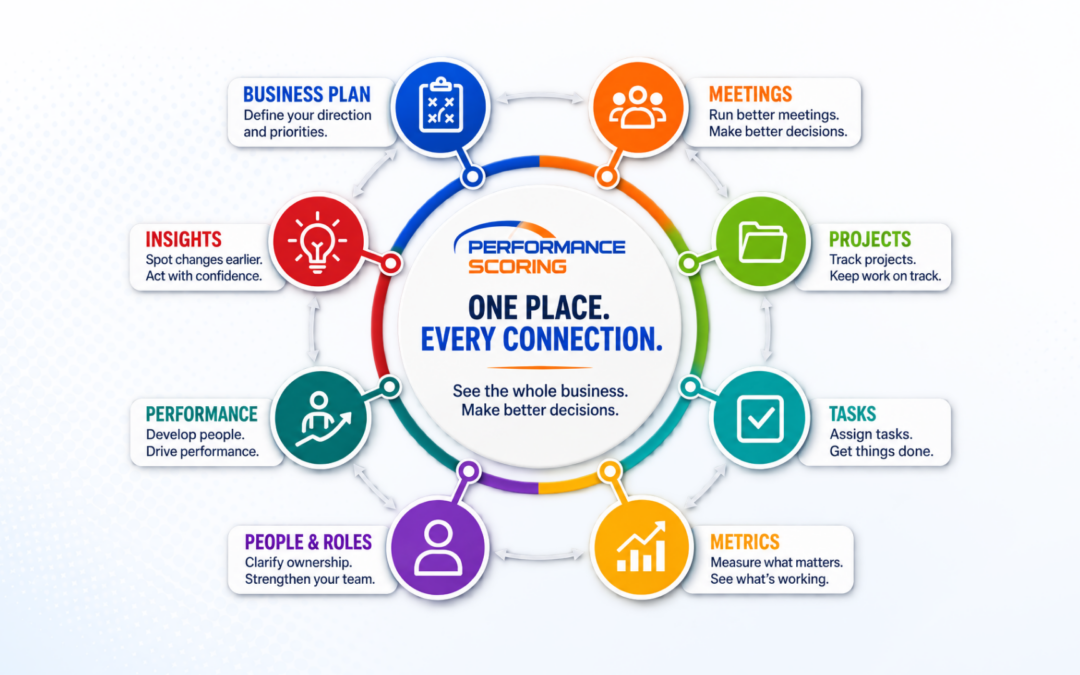
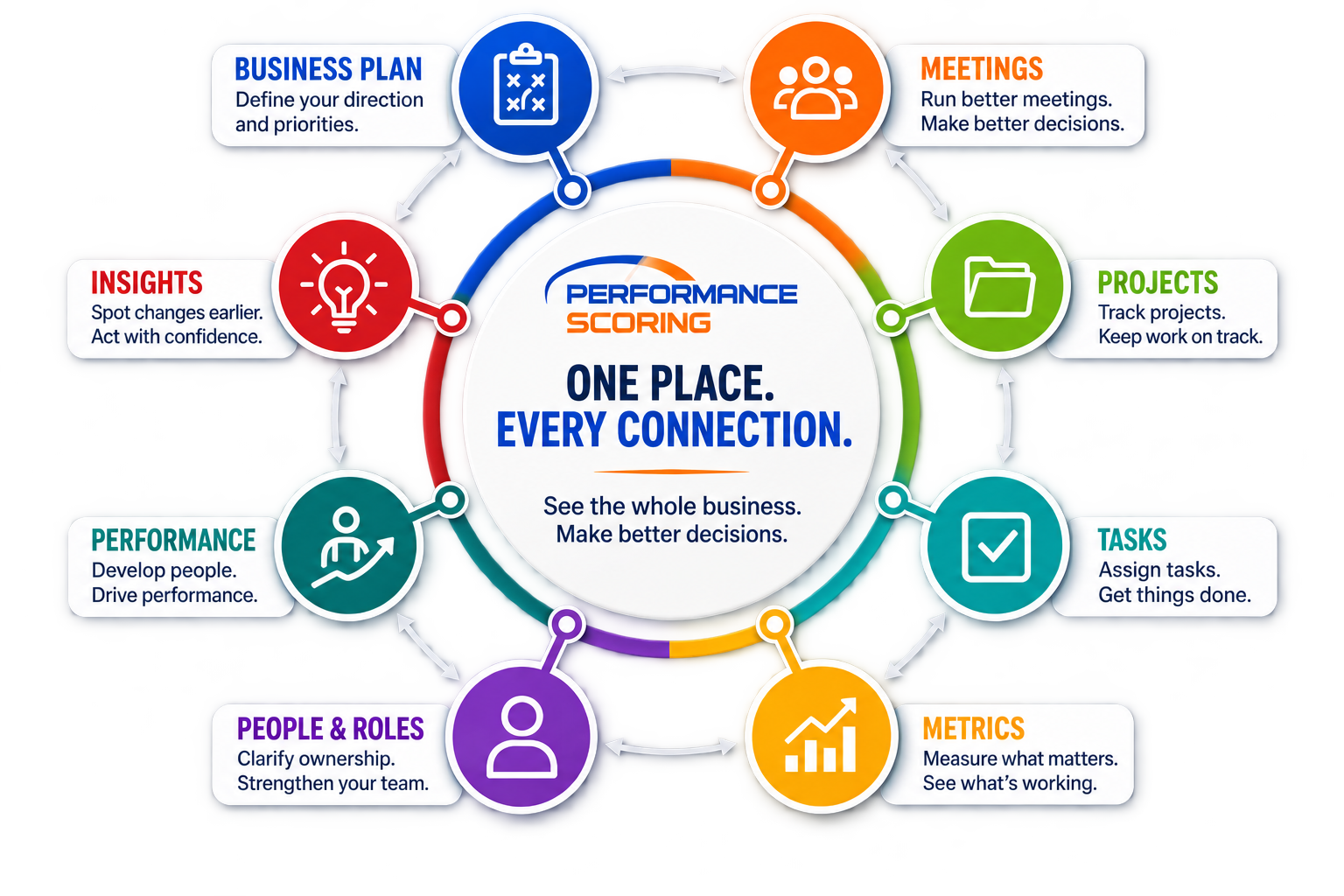
Because your Business Plan, Projects, Tasks, Metrics, Meetings, people, and performance don’t operate independently in the real world.
So why should they operate independently in your business systems?
Most Businesses Aren’t Missing Tools
Think about the technology your company already uses.
You probably have something for Tasks.
Something for Projects.
Something for Meetings.
Spreadsheets for Metrics.
Documents for planning.
Another system for employee performance.
Surveys somewhere else.
Maybe an AI meeting assistant.
And plenty of email, Teams, or Slack conversations filling the gaps.
Each tool may work perfectly well.
But collectively, they create a bigger problem.
The business becomes fragmented.
Your strategy lives in one place.
Execution lives somewhere else.
People performance is separated from both.
Leadership has access to plenty of information, but very little of it tells a connected story.
Connection Changes the Question
When information is disconnected, leaders spend a lot of time asking:
Where is that information?
Who owns this?
Did that get done?
What happened in the Meeting?
Where are we on that Project?
Why did this Metric change?
How is this employee performing?
What’s happening with this department?
Those are information-gathering questions.
When your business becomes more connected, leadership can start asking better questions:
Why is this happening?
What is getting in the way?
What should we do next?
Where do we need to focus?
What opportunity are we missing?
That’s an important shift.
You move from finding information to using information.
It Starts With Direction
Every connected business needs a starting point.
That starts with knowing where you’re going.
Your Business Plan establishes the larger direction.
Where do we want the company to go?
What are our goals?
What are our priorities?
What needs to change?
What opportunities are we pursuing?
What could get in our way?
Without that foundation, execution can become a collection of activity.
People stay busy.
Projects get completed.
Tasks get checked off.
Meetings happen.
But are those activities moving the company toward something meaningful?
A connected system keeps the bigger picture closer to the work.
Direction Becomes Projects
A goal doesn’t become reality because leadership wrote it into a Business Plan.
Someone has to own the work required to achieve it.
That’s where Projects enter the picture.
If the company wants to improve customer retention, what Project will help make that happen?
If leadership wants to expand into a new market, what needs to be built?
If the company wants to improve operational efficiency, what initiative needs to move forward?
Now strategy begins turning into execution.
Instead of:
We want to improve this.
You have:
Here’s what we’re doing about it.
Projects Become Tasks
Projects still don’t execute themselves.
They break down into actions.
Those actions become Tasks.
Who needs to do what?
By when?
What has been completed?
What’s overdue?
What’s blocking progress?
This is where accountability becomes practical.
Instead of simply asking whether a Project is progressing, leaders can see the activity underneath it.
And if a Project moves Off Track, there may already be clues explaining why.
Several Tasks are overdue.
Ownership isn’t clear.
A dependency hasn’t been completed.
An Issue is unresolved.
Now the status has context.
Metrics Tell You Whether the Work Is Producing Results
Completing work doesn’t automatically mean the business is improving.
That’s why Metrics matter.
Projects and Tasks tell you what you’re doing.
Metrics help tell you whether it’s working.
Imagine a company launches a Project designed to improve customer retention.
The Project is completed.
Every Task is checked off.
That’s great.
But what happened to retention?
Did it improve?
Stay the same?
Decline?
Without the Metric, you know the work happened.
You don’t necessarily know whether the work produced the intended result.
That’s why execution and measurement belong together.
Meetings Create the Rhythm
Now bring Meetings into the picture.
A Meeting shouldn’t be where leadership begins searching for all of this information.
It should be where the team uses the information to make decisions.
What moved?
What’s Off Track?
Which Metrics need attention?
What Issues need to be solved?
What decisions need to be made?
What Tasks need to come out of the conversation?
Then those Tasks become part of the execution happening after the Meeting.
At the next Meeting, leadership isn’t starting over.
There’s continuity.
Discuss → Decide → Assign → Execute → Measure → Review
Then repeat.
That’s a business rhythm.
People Connect Everything
There’s still one critical piece missing.
People.
People own the Projects.
People complete the Tasks.
People influence the Metrics.
People participate in the Meetings.
People solve the Issues.
People execute the Business Plan.
That’s why employee performance shouldn’t exist in a completely separate world from business performance.
Your Org Chart can help establish structure, responsibilities, and skills.
Metrics help define measurable expectations.
Projects and Tasks provide visibility into execution.
Check-Ins create opportunities for conversation.
Coaching supports development.
Feedback provides context.
High Fives recognize contributions.
Performance Reviews help evaluate progress over time.
Performance, Alignment, and Engagement provide additional signals.
Now leaders can begin seeing the person in the context of the work they’re actually responsible for.
Business Performance and People Performance Aren’t Separate
This may be one of the biggest ideas we’ve explored throughout this series.
Companies often manage business performance and people performance separately.
Operations looks at results.
HR looks at employees.
Leadership tries to connect the two.
But businesses don’t produce results independently of the people working inside them.
If Projects repeatedly fall behind, there may be an execution issue.
There may also be a capacity, clarity, skill, or ownership issue.
If a Metric declines, there may be a process problem.
There may also be a coaching opportunity.
If an employee is struggling, the answer may not simply be that they’re underperforming.
Their responsibilities may be unclear.
They may be overloaded.
They may lack a skill.
They may be working against competing priorities.
Connected information creates context.
And context helps leaders ask better questions.
Patterns Become Easier to See
Once the pieces begin connecting, individual data points can start telling a larger story.
Imagine this:
A company Metric begins declining.
At the same time, a related Project moves Off Track.
Several Tasks associated with the Project become overdue.
The same operational Issue appears in multiple Meetings.
A department’s Engagement begins declining.
Individually, each item deserves some attention.
Together, they may reveal something much more important.
That’s where connected business visibility becomes powerful.
You aren’t just looking at a Metric.
You’re seeing what may be happening around it.
This Is Where Business Insights Become More Valuable
In the previous article, we explored the idea of Weekly Business Insights.
When business information is disconnected, creating useful insights requires gathering information from multiple places.
But when Business Plans, Projects, Tasks, Metrics, Meetings, Issues, and people performance exist within a connected environment, there’s much more context available.
Instead of simply reporting:
3 Projects are Off Track.
You can begin asking:
Are they connected to the same priority?
Do they share the same owner?
Are related Tasks overdue?
Have the same Issues appeared in Meetings?
Are associated Metrics also changing?
That’s the difference between reporting activity and understanding the business.
Leaders Don’t Need to See Everything
A connected business doesn’t mean leadership should watch every Task, every employee, every Metric, and every Project.
That would create the opposite of clarity.
The goal is to make it easier to identify what deserves attention.
Leadership should be able to move from the whole business into the details when necessary.
Start with:
What’s changing?
Then:
Where is it happening?
Then:
Why might it be happening?
Then:
What should we do?
That’s a much better experience than opening ten different systems and trying to build the picture manually.
One Connected View Creates Better Conversations
Technology isn’t the end goal.
Better leadership conversations are.
Imagine a leadership team sitting down for its weekly Meeting.
Everyone can see the same priorities.
The same Projects.
The same Metrics.
The same Issues.
The same Tasks.
The same business context.
Now the conversation isn’t dominated by competing spreadsheets or conflicting versions of what’s happening.
The team has a shared starting point.
That doesn’t mean everyone will agree on what to do.
They shouldn’t always agree.
But at least they’re discussing the same reality.
Connection Can Reduce the Administrative Burden
There’s another benefit that’s easy to overlook.
Every disconnected system creates administrative work.
Someone updates the Project system.
Someone updates the spreadsheet.
Someone prepares the leadership report.
Someone creates the Meeting agenda.
Someone sends the follow-up.
Someone enters employee performance information.
Someone builds the quarterly presentation.
Sometimes the same information gets entered more than once.
Connecting business information can reduce some of that duplication.
The work employees and managers are already doing begins contributing to the larger picture.
The goal isn’t:
Give everyone another platform to update.
It’s:
Make the information they’re already creating more useful across the business.
What Could Your Business Stop Chasing?
Throughout September, we’ve focused heavily on what leaders could gain from better visibility.
But there’s another way to look at it.
What could you stop doing?
Could you stop asking managers for weekly Project updates?
Could you stop rebuilding the same leadership spreadsheet?
Could you stop searching through Meeting notes for decisions?
Could you stop trying to remember what was discussed during an employee Check-In?
Could you stop piecing together performance information before a Performance Review?
Could you stop wondering whether a company priority actually has work attached to it?
Could you stop logging into multiple platforms just to understand what’s happening?
Sometimes the value of connection isn’t another capability.
It’s removing friction from how the business already operates.
The Goal Is Clarity
This entire September series has been built around one idea:
See Your Business More Clearly.
Not manage every employee more closely.
Not create more reports.
Not track more data just because you can.
Not add more administrative work.
See more clearly.
See where the company is going.
See whether the work supports that direction.
See what’s moving.
See what’s stuck.
See whether results are improving.
See how your people are doing.
See where leadership attention is needed.
See changes earlier.
And eventually, have the most meaningful insights brought directly to you.
That’s what connected business visibility should accomplish.
Put Your Business to the Final Test
We’ve used questions throughout this series, so let’s finish with one final exercise.
Can you trace one of your company’s most important priorities all the way through the business?
Start with the priority.
Where is it documented in your Business Plan?
Then ask:
Which Projects support it?
Who owns those Projects?
Which Tasks are moving them forward?
Which Metrics tell you whether they’re working?
Which employees are responsible for the results?
What Issues are getting in the way?
Where are those Issues being discussed?
What decisions have been made?
Are those decisions turning into action?
How would leadership know if the priority started falling behind?
If you can follow that entire path easily, you have strong business visibility.
If every answer sends you somewhere different, there’s an opportunity to connect the pieces.
See Your Business More Clearly
Over the course of September, we’ve explored Performance Scoring from the ground up.
We started with direction.
Then we followed the work.
We looked at the people.
And finally, we stepped back to see the whole business.
The individual tools matter.
But the bigger opportunity is what happens when they stop operating as individual tools.
Business Plan → Projects → Tasks → Metrics → Meetings → People → Performance → Insights → Action
That’s the connected story of your business.
And when leadership can see that story more clearly, they can spend less time trying to figure out what’s happening and more time deciding what happens next.
Now It’s Your Turn to See It
Reading about business visibility is one thing.
Seeing your own company through that lens is different.
That’s why we’re closing our September series with an invitation to put the idea to the test.
Take the Performance Scoring 30-Day Business Challenge.
Bring in your real Business Plan.
Your real Projects.
Your real Metrics.
Your real Meetings.
Your real team.
Then ask yourself after 30 days:
Can I see my business more clearly than I could before?
If the answer is yes, you’ve gained something much more valuable than another piece of software.
You’ve gained clarity.
Visit PerformanceScoring.com or email us at support@performancescoring.com to learn more or take the 30-Day Business Challenge and experience the platform with your own team.
References and further reads:
MIT Center for Information Systems Research – Build Business Advantage With Real-Time Decision-Making
MIT CISR article
McKinsey & Company – Organizational Health: A Fast Track to Performance Improvement
McKinsey article
Harvard Business Review – Making Your Strategy Work on the Frontline
Harvard Business Review article