Most business problems don’t appear overnight.
A Project rarely becomes seriously delayed in a single day.
Employee performance usually doesn’t decline all at once.
Customer issues don’t suddenly multiply without some kind of signal.
Margins don’t disappear without numbers beginning to move.
Engagement doesn’t typically fall because of one bad afternoon.
Most problems leave clues.
The challenge is whether leadership can see those clues early enough to do something about them.
Because there’s a big difference between knowing what went wrong and knowing something is starting to go wrong.
Most Reporting Tells You What Already Happened
Traditional business reporting is often backward-looking.
What was revenue last month?
What was our quarterly profit?
How many Projects did we complete?
How did employees perform last year?
How many customers did we lose?
Those numbers are important.
But by the time you’re reviewing them, the outcome has already happened.
You can’t go back and change last month’s revenue.
You can’t recover a deadline that passed six weeks ago.
You can’t fix an employee experience problem after a great employee has already left.
Historical information helps you learn.
Earlier visibility gives you an opportunity to act.
An Earlier Warning Doesn’t Have to Be Complicated
When people hear phrases like predictive analytics or early warning systems, it can sound like something reserved for huge companies with sophisticated data teams.
It doesn’t have to be.
Sometimes an earlier warning is simply noticing that something has changed.
A Metric that normally stays above goal misses for two consecutive weeks.
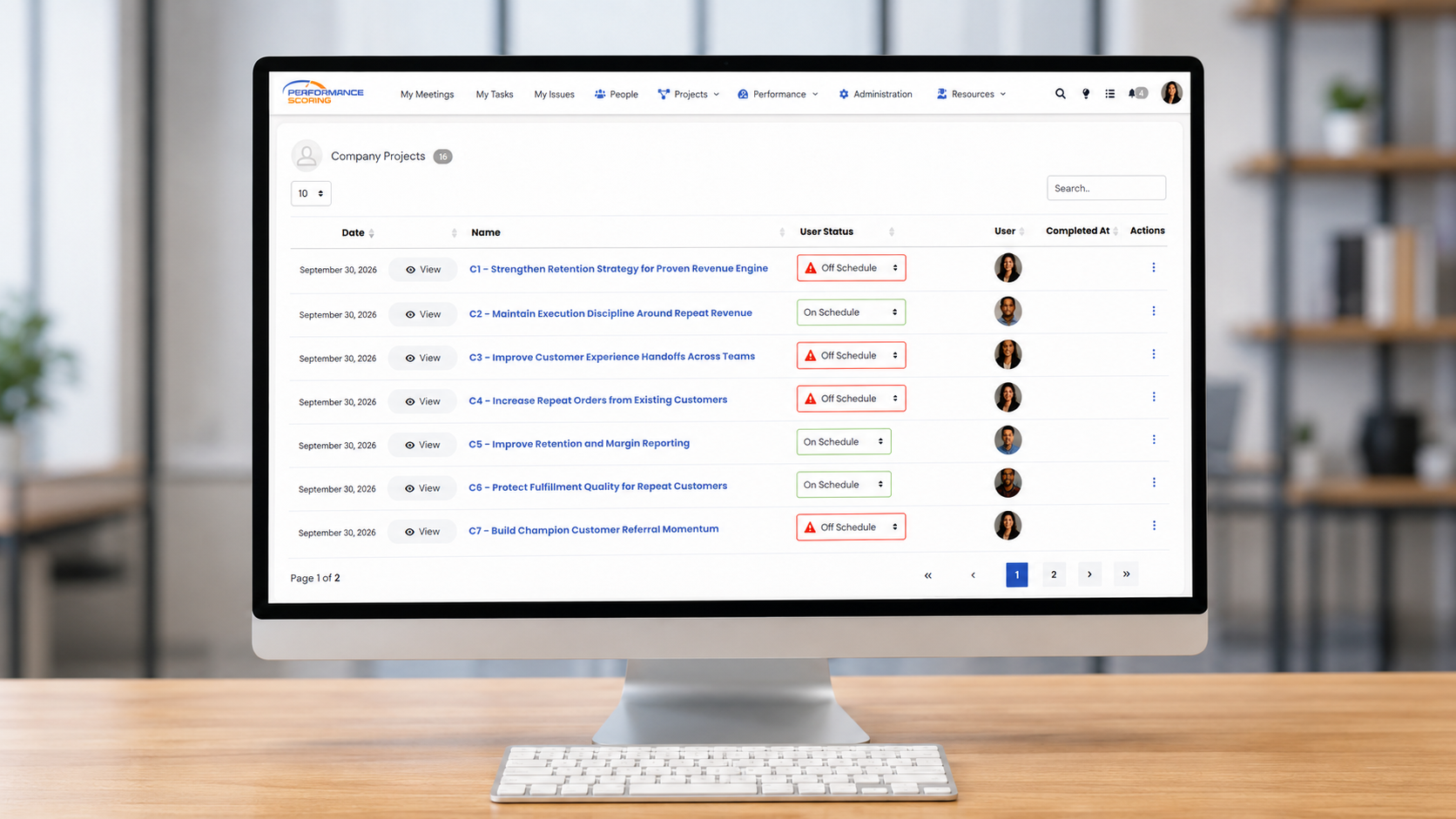
A Project that was On Track moves Off Track.
An employee who consistently completes Tasks on time starts missing deadlines.
A team that normally participates actively in Meetings becomes noticeably quieter.
Check-In feedback begins showing the same concern across several employees.
Alignment or Engagement begins trending downward.
None of these automatically means there’s a serious problem.
They’re signals.
And signals give leaders a reason to look closer.
A Red Metric Is Information
We’ve talked about red throughout this series because it’s one of the simplest examples.
Imagine a weekly sales Metric has a goal of 100.
For months, the team consistently hits 105, 110, 108, 112.
Then performance changes:
If leadership only looks at whether the Metric is red or green this week, they see a missed goal.
But the trend tells a bigger story.
Something is changing.
Maybe lead volume is down.
Maybe conversion rates changed.
Maybe a salesperson left.
Maybe the market shifted.
Maybe the team has a capacity problem.
The Metric doesn’t necessarily tell you why.
But it gives you an earlier opportunity to ask:
What’s happening?
Trends Matter More Than Isolated Moments
One bad week isn’t always meaningful.
That’s why leaders need context.
A Project can temporarily move Off Track because someone was out sick.
A Metric can miss because of a holiday.
An employee can have a difficult week.
A department can experience a temporary bottleneck.
The goal isn’t to react dramatically every time something changes.
It’s to recognize patterns.
Is the Metric continuing to decline?
Has the Project been Off Track for three weeks?
Are overdue Tasks increasing?
Is the same Issue appearing repeatedly in Meetings?
Is employee Engagement moving in the wrong direction?
Patterns help leadership distinguish between a temporary event and something that may require intervention.
Projects Often Tell You Before the Deadline
Imagine a Project is due in eight weeks.
Technically, it isn’t late.
So everything looks fine.
But several Tasks are overdue.
A key milestone has slipped.
An Issue discussed in the last two Meetings still hasn’t been resolved.
The person responsible for the Project has marked it Off Track.
You already have information.
Waiting eight weeks for the final deadline to confirm the Project is late doesn’t create accountability.
It creates a missed opportunity.
Earlier visibility allows leadership to ask:
What is blocking progress?
Do we need additional resources?
Has the scope changed?
Is the deadline still realistic?
Does ownership need clarification?
The best time to rescue a Project is before it fails.
Your People Give You Signals Too
Earlier warnings aren’t limited to operational data.
People provide signals.
An employee who was highly engaged stops participating.
Performance begins slipping across several Metrics.
A strong performer starts missing deadlines.
Check-Ins become increasingly negative.
Manager feedback begins identifying the same issue repeatedly.
An employee’s Alignment score changes significantly.
Again, none of these automatically means the employee has a performance problem.
There may be a perfectly reasonable explanation.
But without visibility, a manager may not even realize a conversation is needed.
This connects directly to what we discussed during Week 3.
Performance data shouldn’t replace human conversations.
It should help leaders know when to have them.
Earlier Visibility Can Change the Conversation
Think about the difference between these two conversations.
The first happens after something has already failed:
We missed the deadline. What happened?
The second happens earlier:
It looks like we’re starting to fall behind. What do you need to get this back on track?
Those are very different leadership conversations.
One is about explaining the past.
The other is about influencing the future.
The same applies to employee performance.
Instead of:
Your performance has been below expectations for the last quarter.
A manager can say:
I’ve noticed this Metric has been trending down for the last few weeks. Is something getting in your way?
Earlier visibility creates more opportunities for coaching, problem-solving, and support before the issue becomes much larger.
Don’t Turn Every Signal Into an Alarm
There’s also a danger in having more visibility.
Leaders can become overly reactive.
Every red Metric becomes an emergency.
Every overdue Task triggers a message.
Every Project status change creates a meeting.
Every employee performance fluctuation becomes a coaching session.
That’s not the goal.
Good visibility should help leaders prioritize attention, not create more noise.
The question isn’t:
What changed?
It’s:
What changed enough that we should understand why?
That’s an important distinction.
From Signals to Business Insights
This is where business visibility can become especially valuable.
Imagine leadership doesn’t have to manually review every Metric, Project, Task, Meeting, and employee to find what changed.
Instead, the most meaningful changes begin surfacing as business insights.
For example:
A critical Metric has missed goal three weeks in a row.
Three Projects connected to the same company priority are Off Track.
Task completion has declined across one department.
A previously strong performance trend has changed.
Several employee Check-Ins mention the same obstacle.
An Issue continues appearing across multiple Meetings.
Now leadership isn’t just looking at data.
They’re being directed toward the areas that may deserve attention.
That’s the difference between a dashboard and an insight.
A dashboard shows you information.
An insight helps you know where to look.
Imagine Receiving the Insight Before You Ask for It
This is where the way leaders consume business information can begin to change.
Traditionally, leadership has to go find the information.
Log in.
Open a dashboard.
Run a report.
Ask a manager.
Review a spreadsheet.
Search through Meeting notes.
But what if the most important business insights came to leadership instead?
Imagine starting the week with a simple summary:
3 Metrics need attention.
2 Projects moved Off Track.
Task completion improved 12% in Operations.
Engagement declined in one team.
A recurring Issue appeared in three Meetings.
One company priority has no active Project supporting it.
Now leadership has a starting point.
They can dig deeper where needed without manually reviewing every part of the business.
The Goal Isn’t Prediction. It’s Preparation.
No platform can perfectly predict what’s going to happen inside a business.
And leaders shouldn’t expect it to.
There are too many variables.
People change.
Markets change.
Customers change.
Priorities change.
Unexpected things happen.
The value of earlier business insights isn’t predicting the future with certainty.
It’s giving leadership more time to respond to what is already beginning to change.
That’s a much more practical goal.
See earlier. Understand faster. Respond sooner.
How Performance Scoring Creates the Foundation for Earlier Insights
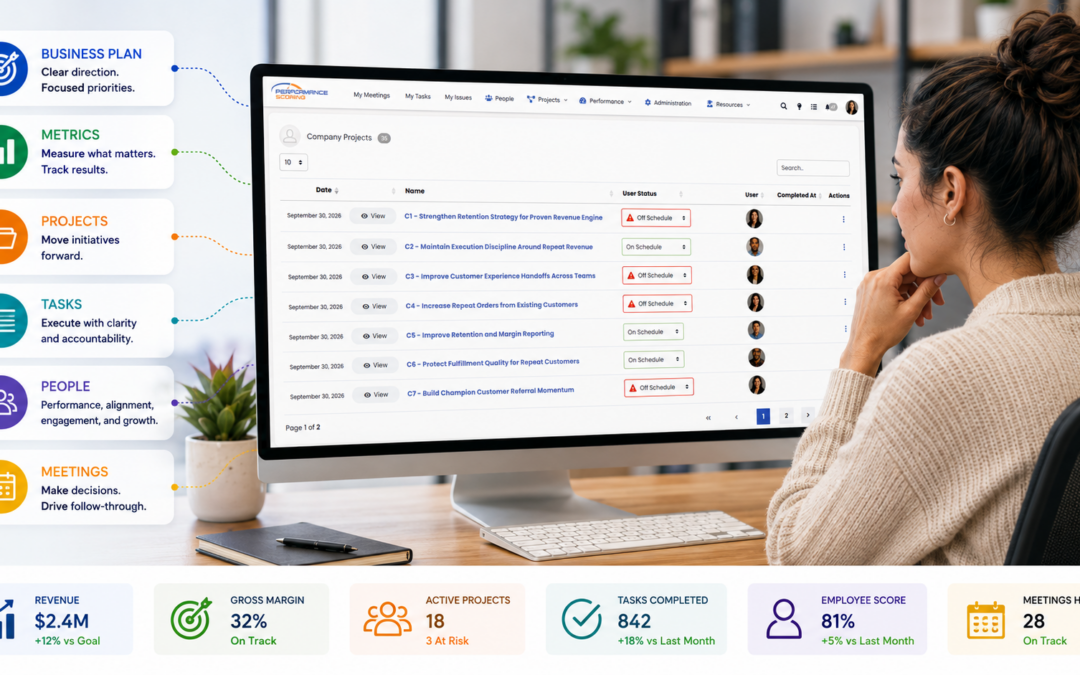
Throughout this September series, we’ve been connecting different areas of the business.
Your Business Plan establishes direction.
Projects show whether strategic work is moving.
Tasks provide visibility into execution.
Metrics show measurable results and trends.
Meetings capture Issues, decisions, and follow-through.
Your Org Chart provides context around responsibilities and people.
Performance Reviews, Check-Ins, Coaching, and Feedback provide additional employee performance context.
Performance, Alignment, and Engagement provide signals around your people.
When those pieces exist in completely separate systems, finding relationships between them becomes difficult.
When they’re connected, leadership has a much stronger foundation for identifying meaningful changes across the business.
And that’s where the opportunity for better business insights begins.
Put Your Early Warning System to the Test
Think about the last significant problem your business experienced.
Maybe it was:
A missed deadline.
A lost customer.
An employee resignation.
A major Metric falling below goal.
A Project failure.
A capacity problem.
A financial surprise.
Then ask:
When did the problem actually begin?
Now ask:
When did leadership realize it was a problem?
There’s often a gap between those two moments.
That gap is the opportunity.
What information existed earlier?
Was there a trend?
A missed Metric?
An unresolved Issue?
A change in performance?
A Project moving Off Track?
Employee feedback?
A pattern leadership didn’t see?
The goal isn’t to eliminate every surprise.
That’s impossible.
The goal is to shorten the distance between when something starts changing and when leadership sees it.
See the Whole Business Earlier
This continues Week 4: See the Whole Business in our September See Your Business More Clearly series.
In our last article, we asked whether leadership could see the health of the business without chasing down information.
Now we’re taking that idea one step further.
It’s not enough to see what’s happening.
The real opportunity is seeing what’s changing.
Because the earlier leadership can identify a meaningful shift, the more options they have for responding to it.
Next, we’ll explore:
What If Your Business Insights Came to You?
We’ll look at how weekly leadership insights could bring important changes, trends, risks, wins, and opportunities directly to leaders instead of requiring them to continuously search for the information themselves.
What Would an Earlier Warning Be Worth to Your Business?
Performance Scoring connects Metrics, Projects, Tasks, Meetings, Issues, employee performance, Alignment, Engagement, Check-Ins, Coaching, and company priorities to create greater visibility into what’s happening across your organization.
Because sometimes the most valuable business information isn’t what happened last quarter.
It’s what is starting to happen right now.
Visit PerformanceScoring.com or email us at support@performancescoring.com to learn more or take the 30-Day Business Challenge and experience the platform with your own team.
References and further reads:
MIT Center for Information Systems Research – Build Business Advantage With Real-Time Decision-Making
MIT CISR article
McKinsey & Company – Organizational Health: A Fast Track to Performance Improvement
McKinsey article
Harvard Business Review – Making Your Strategy Work on the Frontline
Harvard Business Review article