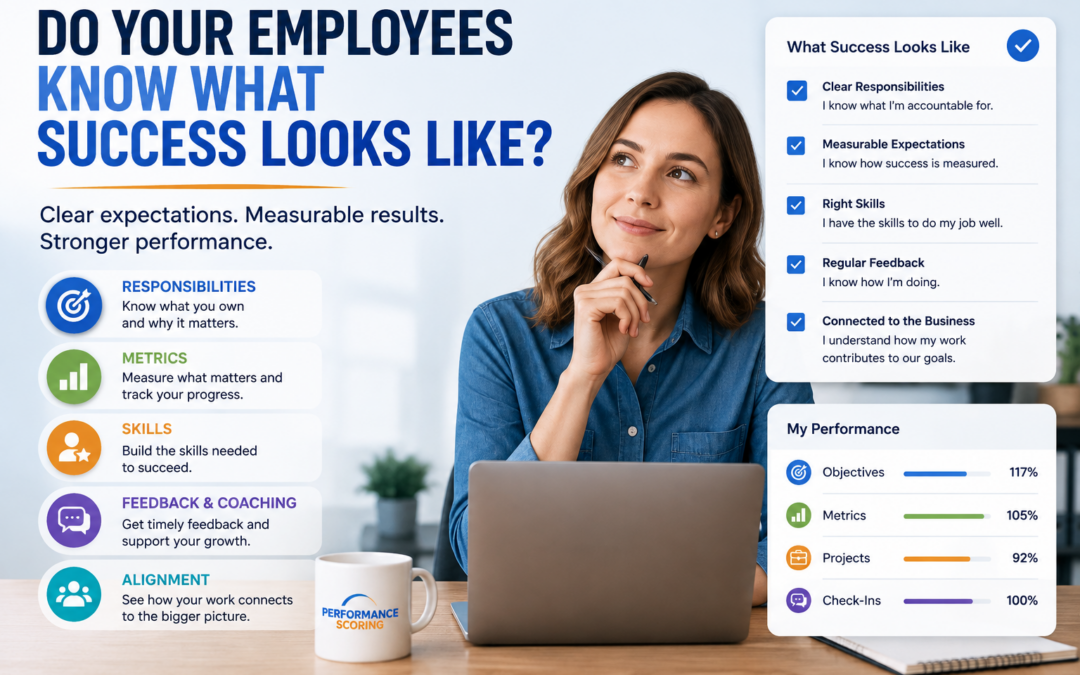
Ask ten employees what success looks like in their role, and you may get ten very different answers.
One person might say:
Getting everything on my Task list done.
Another might say:
Keeping my manager happy.
Someone else might point to a sales goal, customer satisfaction score, Project deadline, or simply say:
I’m really not sure.
That last answer should concern leaders.
Because employees can’t consistently meet expectations they don’t clearly understand.
And managers can’t fairly hold people accountable when success hasn’t been clearly defined.
Employee performance starts with clarity.
Being Busy Doesn’t Mean Someone Knows What’s Expected
Most employees know what they’re supposed to do every day.
Answer emails.
Attend Meetings.
Complete Tasks.
Help customers.
Manage Projects.
Prepare reports.
But knowing what to do isn’t necessarily the same as knowing what successful performance looks like.
Consider a customer service employee.
Their responsibility may be to respond to customer requests.
But what does success mean?
Respond within two hours?
Resolve 90% of requests without escalation?
Maintain a specific customer satisfaction score?
Follow up within 24 hours?
Those expectations create a much clearer picture than:
Provide excellent customer service.
One is an aspiration.
The other gives the employee something they can understand and work toward.
Start With Clear Responsibilities
Every position exists for a reason.
Yet responsibilities can become surprisingly unclear as companies grow.
Someone gets hired to do one thing.
Then they pick up another responsibility.
A coworker leaves, so they inherit part of that person’s job.
The department grows.
Processes change.
New technology gets introduced.
Three years later, the employee’s actual responsibilities may look very different from the position they originally accepted.
That’s why responsibilities shouldn’t live exclusively in a job description created during hiring.
They should remain visible and relevant.
An employee should be able to answer:
What am I ultimately responsible for?
Their manager should be able to answer the same question.
If those answers are different, you have a clarity problem.
Responsibilities Tell You What. Metrics Help Define How Well.
Responsibilities establish ownership.
Metrics can make expectations measurable.
Let’s say someone is responsible for generating qualified sales opportunities.
That’s useful.
But how will they know whether they’re succeeding?
Maybe the expectation is:
20 qualified opportunities per month.
A specific pipeline value.
A target conversion rate.
A certain number of prospecting conversations.
Now the employee isn’t guessing.
There’s a measurable definition of expected performance.
Metrics don’t need to capture every part of someone’s job.
In fact, they shouldn’t.
The goal is to identify the handful of numbers that help the employee and manager understand whether the most important outcomes of the position are on track.
Skills Matter Too
Someone can understand their responsibilities and still struggle because they haven’t developed the skills necessary to perform them successfully.
That’s a different problem.
Imagine a new manager.
They understand that they’re responsible for leading their department.
But what skills does that require?
Communication?
Delegation?
Coaching?
Conflict resolution?
Financial understanding?
Decision-making?
Planning?
If those expectations aren’t defined, development becomes vague.
A manager may tell the employee:
You need to become a stronger leader.
But what exactly does that mean?
Identifying the skills associated with a position makes the conversation much more useful.
Now you can ask:
Which skills are already strengths, and which ones should we develop next?
Employees Shouldn’t Have to Guess How They’re Performing
There’s another part of performance clarity that’s often overlooked.
It’s not enough for employees to know what’s expected.
They also need to know how they’re doing against those expectations.
Imagine playing a game without being able to see the score.
You know the rules.
You know what you’re supposed to do.
But nobody tells you whether you’re winning or losing until the game is over.
That would be frustrating.
Yet that’s essentially what happens when employees receive very little performance feedback between annual reviews.
Employees should have access to enough information and communication to understand:
What’s going well.
What’s off track.
Where they’ve improved.
Where they need support.
What their manager expects next.
That’s where Metrics, Check-Ins, Coaching, Feedback, and Performance Reviews begin working together.
Alignment Creates Another Layer of Clarity
Someone can perform well individually and still be disconnected from the direction of the organization.
That’s why success isn’t only about individual output.
Employees also need context.
Why does my work matter?
How does my Metric connect to the department?
How does my Project support a company priority?
Why is this Task important?
How does my position contribute to where the business is going?
When people understand those connections, work becomes less isolated.
Instead of:
My manager told me to do this.
The employee can understand:
This is how my work contributes to what we’re trying to accomplish.
That’s a very different level of clarity.
Connect Individual Work to the Business Plan
This is where the pieces we’ve discussed throughout this September series start coming together.
The company establishes its direction through the Business Plan.
That direction creates priorities.
Priorities become Projects.
Projects create Tasks.
Results are measured through Metrics.
People own the responsibilities required to make those things happen.
And Meetings create the rhythm for reviewing progress, addressing obstacles, and deciding what happens next.
That creates a connected line:
Business Plan → Projects → Tasks → Metrics → People → Meetings
When employees can see that connection, they aren’t simply completing work.
They can understand how their work contributes to the larger organization.
Clarity Makes Accountability Fairer
Accountability sometimes gets interpreted as:
Did you do what I told you to do?
But good accountability starts much earlier.
Were expectations clear?
Did the employee understand the goal?
Was ownership defined?
Did they have the skills and resources required?
Was progress visible?
Did the manager provide feedback when something started going off track?
If the answer to those questions is yes, accountability becomes much more straightforward.
Both the manager and employee understand what was expected.
There’s less ambiguity.
Less relying on memory.
Less disagreement over what success was supposed to look like.
Clarity creates the foundation for healthy accountability.
Managers Need Clarity Too
This isn’t only an employee issue.
Managers also benefit when expectations are clearly defined.
Without visibility, managers can spend a tremendous amount of time trying to figure out what’s happening.
They ask for updates.
Search through spreadsheets.
Check Project systems.
Review emails.
Look for old meeting notes.
Try to remember previous conversations.
Then they attempt to piece together a performance picture.
When responsibilities, Metrics, Projects, Tasks, feedback, and performance information are connected, the manager has a much better starting point.
Instead of asking:
What has this person been doing?
They can focus on:
What do they need from me?
That’s a much better use of management time.
How Performance Scoring Helps Define Success
Performance Scoring helps organizations bring the different pieces of employee expectations and performance together.
Your Org Chart can provide clarity around where someone sits in the organization, their responsibilities, and the skills associated with their position.
Metrics create measurable expectations.
Projects and Tasks provide visibility into execution and ownership.
Check-Ins give managers and employees opportunities to discuss progress and obstacles.
Coaching supports development.
Feedback provides timely context.
High Fives recognize positive contributions.
Performance Reviews create structured opportunities to evaluate progress over time.
And Performance, Alignment, and Engagement insights can give managers additional signals about the employee experience.
Together, those tools help answer a much more useful question than:
Is this employee good at their job?
Instead, leaders can begin asking:
Does this person understand what success looks like, and are we giving them the clarity, feedback, and support they need to achieve it?
Put Your Expectations to the Test
Choose one position in your company.
Then imagine a brand-new employee starts in that position tomorrow.
Could you clearly explain:
What they’re responsible for?
What skills they need?
Which Metrics matter?
What Projects they own?
How their performance will be evaluated?
How frequently they’ll receive feedback?
What success looks like after 30, 60, and 90 days?
How their work contributes to company goals?
Now ask the employee currently sitting in that position the same questions.
Would your answers match?
If not, you’ve identified an opportunity to create greater clarity.
See the People More Clearly
This concludes Week 3: See the People in our September See Your Business More Clearly series.
We’ve explored the Org Chart, looked at employee performance from multiple angles, and discussed why performance management should happen throughout the year.
Now we’ve added another critical piece:
Clear expectations.
Because before you can measure performance, coach improvement, or create accountability, people need to understand what success actually looks like.
Next, we’ll move into Week 4: See the Whole Business.
We’ll start connecting everything we’ve covered so far with a bigger leadership question:
Can You See the Health of Your Business Without Chasing Down the Information?
We’ll explore what happens when your Business Plan, people, Projects, Tasks, Metrics, Meetings, and performance insights begin creating one connected view of the organization.
Ready to Create More Clarity for Your People?
Performance Scoring connects responsibilities, skills, Metrics, Projects, Tasks, Check-Ins, Coaching, Feedback, Performance Reviews, and company priorities so employees can better understand what’s expected and managers can have more informed conversations about performance.
Visit PerformanceScoring.com or email us at support@performancescoring.com to learn more or take the 30-Day Business Challenge and experience the platform with your own team.
References and further reads:
- McKinsey & Company – Organizational Health: A Fast Track to Performance Improvement
McKinsey article - Harvard Business Review – Making Your Strategy Work on the Frontline
Harvard Business Review article - MIT Center for Information Systems Research – Build Business Advantage With Real-Time Decision-Making
MIT CISR article