When someone asks how an employee is performing, the answer often depends on who you ask.
A manager might think they’re doing great.
A Metric might show they’re falling behind.
Their Projects may all be on schedule.
Their Tasks may consistently get completed.
They may be highly engaged with the company but struggling in one specific area of their role.
So which one tells you how they’re actually performing?
All of them.
Employee performance is rarely represented accurately by a single number, annual review, or manager’s gut feeling.
To understand how someone is really doing, leaders need a more complete picture.
Performance Is More Than Productivity
It’s easy to associate performance with output.
Did they hit their goal?
Did they complete their Tasks?
Did they finish their Projects?
Those things absolutely matter.
But they don’t tell the whole story.
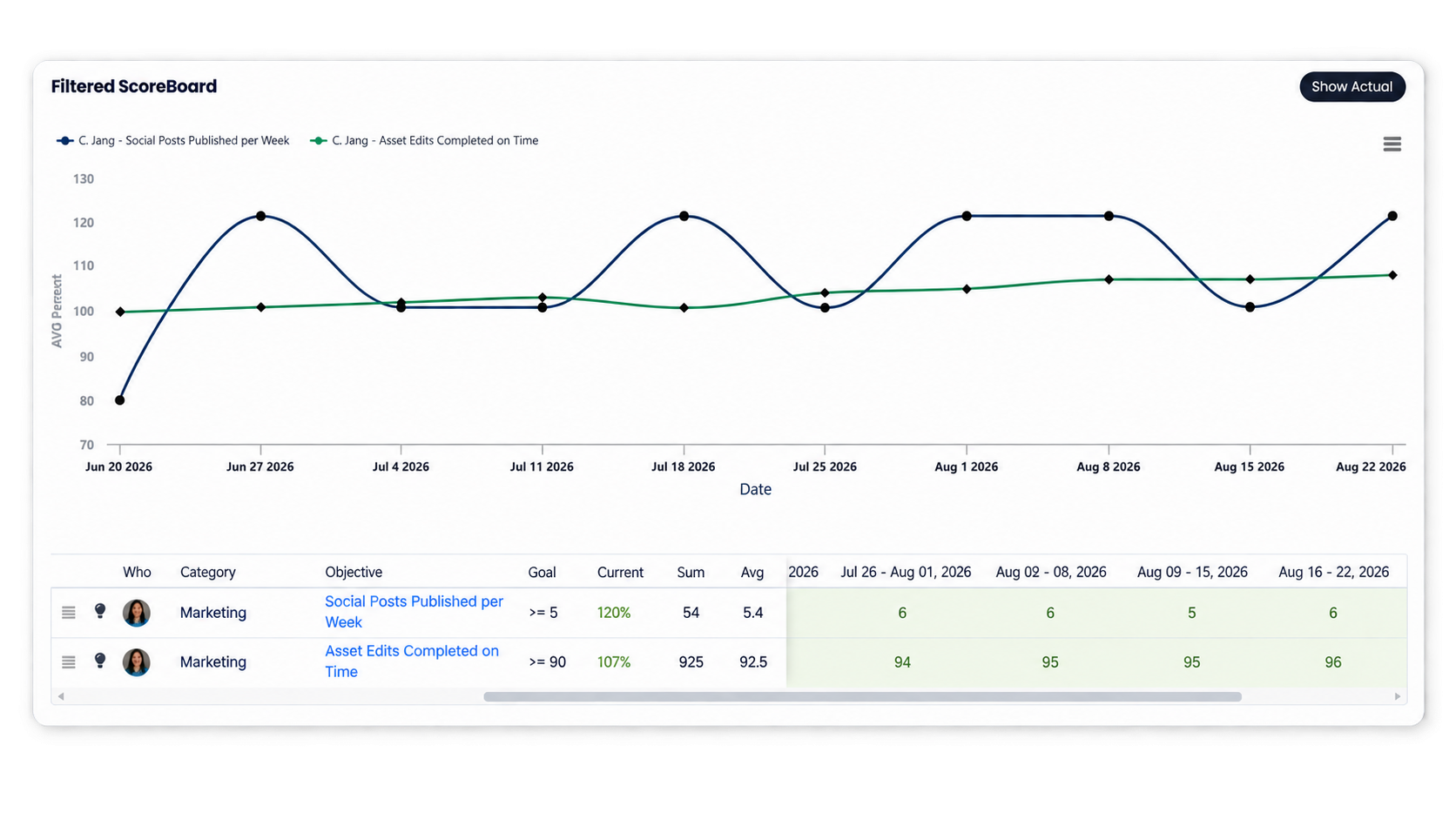
Consider two employees who both hit 100% of their monthly goals.
One consistently completes work on time, collaborates with the team, takes ownership, and stays engaged.
The other hits the same numbers but regularly misses deadlines, creates issues for teammates, and requires significant manager intervention.
On paper, their results might look identical.
In reality, their overall performance looks very different.
That’s why employee performance visibility needs to go beyond a single Metric.
Look at Performance From Multiple Angles
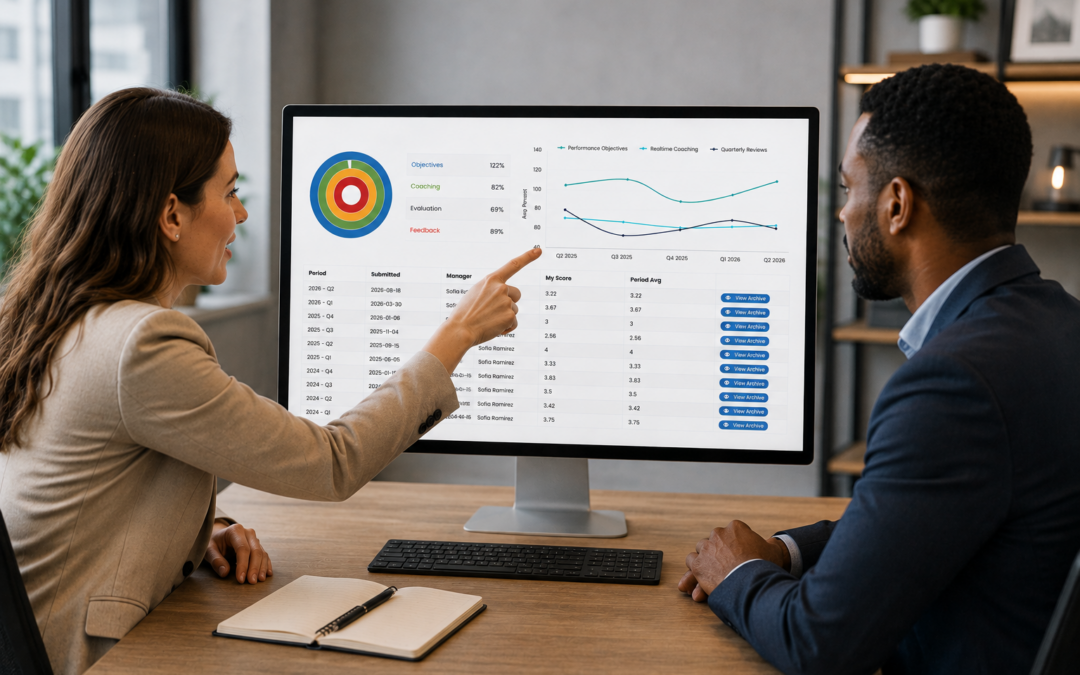
A clearer picture starts to emerge when managers can look at multiple performance signals together.
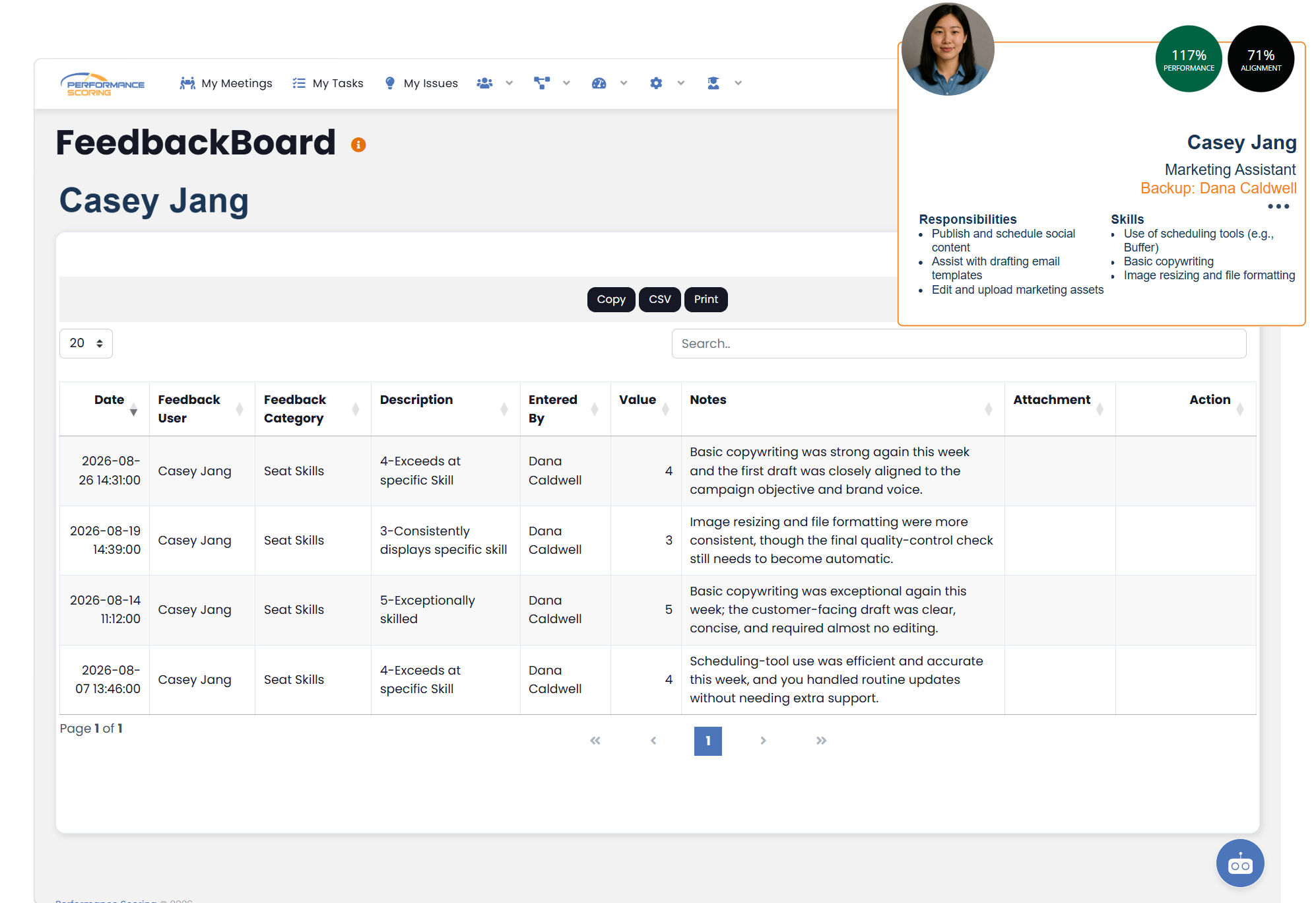
That might include:
- Metrics and measurable results
- Project progress
- Task completion
- Responsibilities
- Performance Reviews
- Check-ins
- Manager feedback →
- Coaching conversations
- Alignment
- Engagement
Individually, each provides a piece of information.
Together, they provide context.
And context is what helps managers move from simply evaluating employees to actually helping them improve.
Metrics Tell You What. Conversations Help You Understand Why.
In our last article, we discussed how an off-track Metric isn’t automatically a sign of poor performance.
That’s especially important when looking at individual employees.
Imagine someone’s weekly Metric suddenly drops below goal.
There could be dozens of reasons.
Maybe they were out of the office.
Maybe priorities shifted.
Maybe another department created a bottleneck.
Maybe they’re missing a resource.
Maybe the goal isn’t realistic anymore.
Or maybe there really is a performance issue that needs to be addressed.
The Metric tells the manager:
Something changed.
It doesn’t always tell them:
Here’s why it changed.
That’s where visibility should lead to conversation.
Performance Data Should Start Conversations, Not Replace Them
There’s an important distinction between tracking people and understanding performance.
The goal shouldn’t be to watch every move an employee makes.
That’s not good leadership, and it’s not particularly useful.
Instead, performance information should help managers recognize when a conversation could be valuable.
If someone’s performance has been trending upward, acknowledge it.
If engagement appears to be slipping, check in.
If Metrics repeatedly fall below expectations, understand why.
If Projects consistently move forward and Tasks are completed, recognize the consistency.
If someone is struggling, determine whether the issue is accountability, clarity, skill, capacity, resources, or something else entirely.
The data gives you a starting point.
Leadership still requires a conversation.
Stop Waiting for the Annual Performance Review
For many employees, the traditional performance process still revolves around an annual review.
Once a year, everyone tries to remember what happened during the previous 12 months.
Managers gather notes.
Employees complete forms.
Ratings are assigned.
Goals are discussed.
Then everyone goes back to work.
The problem is that performance happens every week, not once a year.
If an employee needed coaching in March, waiting until December isn’t particularly helpful.
If someone made tremendous progress in June, that shouldn’t be forgotten because their manager is trying to reconstruct an entire year from memory.
Performance management becomes much more useful when it happens continuously.
Use Check-Ins to Keep the Conversation Going
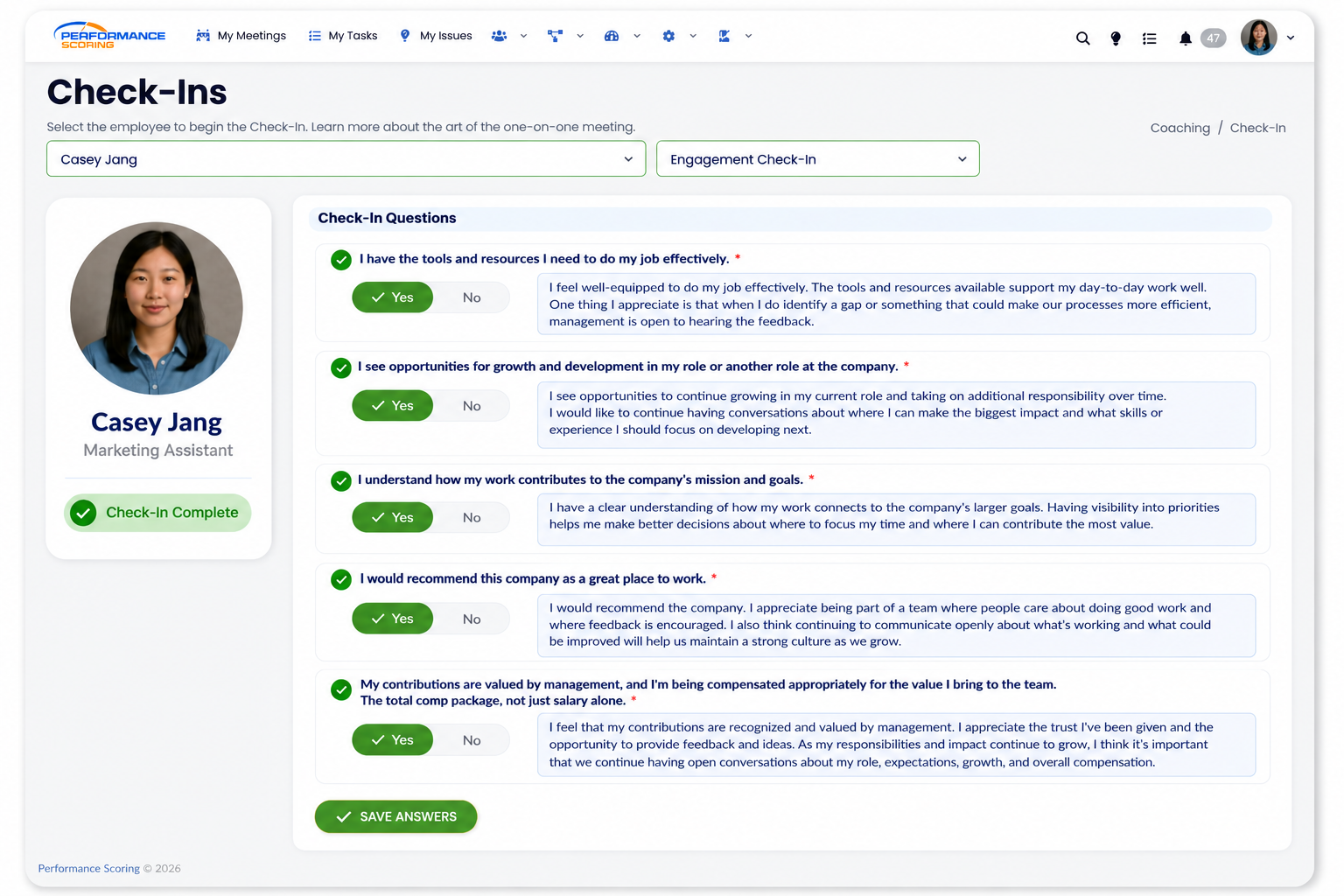
Not every performance conversation needs to be formal.
Sometimes the most valuable question a manager can ask is:
How are things going?
Regular check-ins create opportunities to talk about:
What’s working.
What’s frustrating.
Where someone needs support.
What they’re trying to improve.
What their manager could do differently.
Where they want to grow.
Whether priorities are clear.
These conversations can help managers identify issues earlier and create stronger relationships with their teams.
They also give employees an opportunity to provide context that performance data alone could never capture.
Coaching Should Connect to What You’re Seeing
Better performance visibility can also make coaching more specific.
Instead of saying:
You need to improve your performance.
A manager can have a much more useful conversation.
Maybe a particular Metric has been off track for several weeks.
Maybe Projects are moving but deadlines are frequently missed.
Maybe the employee’s results are strong, but engagement appears to be declining.
Maybe a Performance Review identified a skill the employee wants to develop.
Now coaching has context.
You can talk about a specific behavior, result, responsibility, or development opportunity and determine what happens next.
That’s much more actionable than a vague conversation about doing better.
Recognition Is Part of Performance Management Too
Performance management shouldn’t only show up when something goes wrong.
Leaders also need visibility into what’s going right.
Who consistently delivers?
Who improved significantly?
Who helped another team?
Who stepped up during a difficult Project?
Who deserves recognition?
Those moments matter.
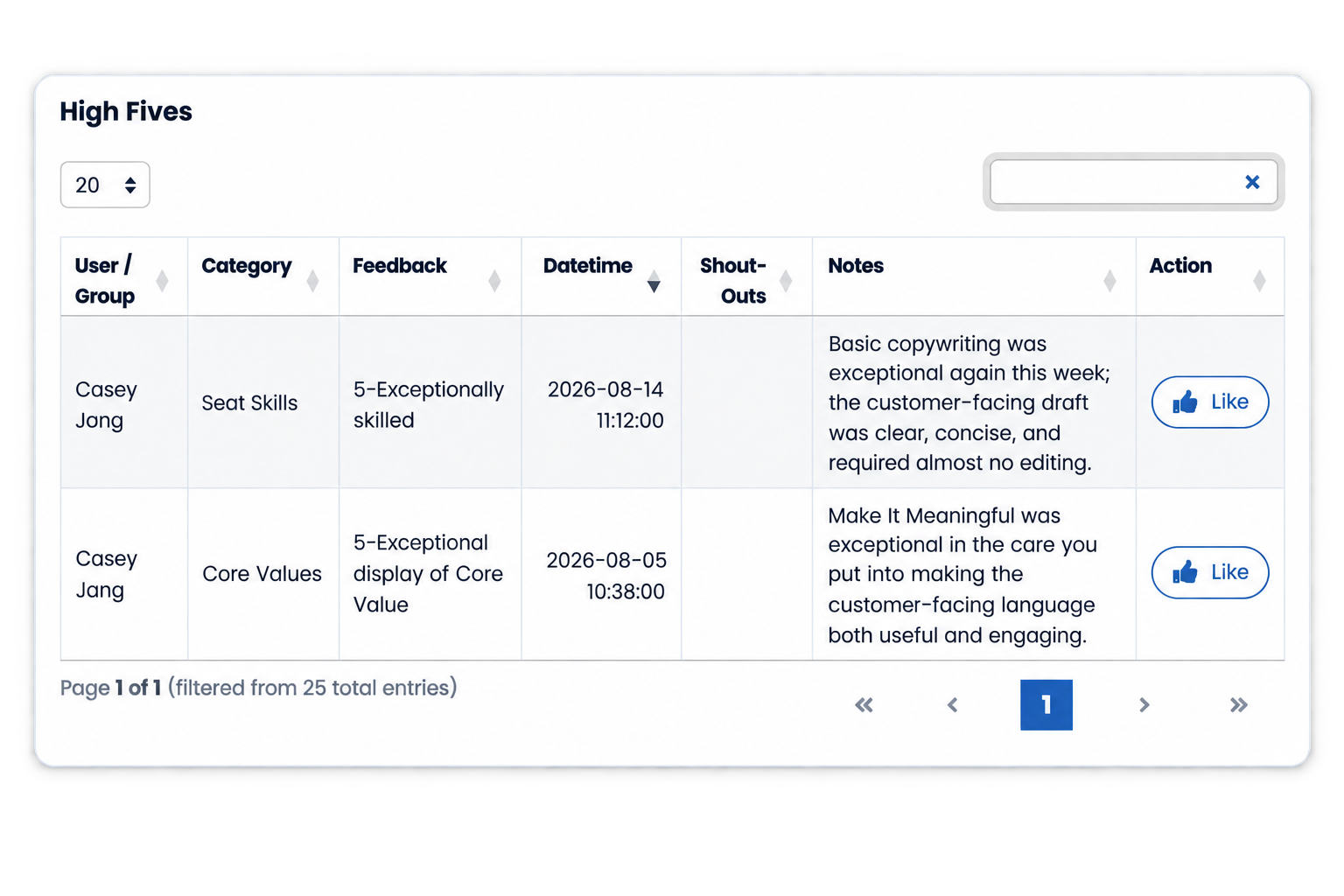
When managers can see positive performance more clearly, they have more opportunities to acknowledge it.
And recognition doesn’t always need to be complicated.
Sometimes a simple High Five or timely piece of positive feedback reinforces exactly the behaviors you want to see more often.
See Performance in the Context of the Person’s Role
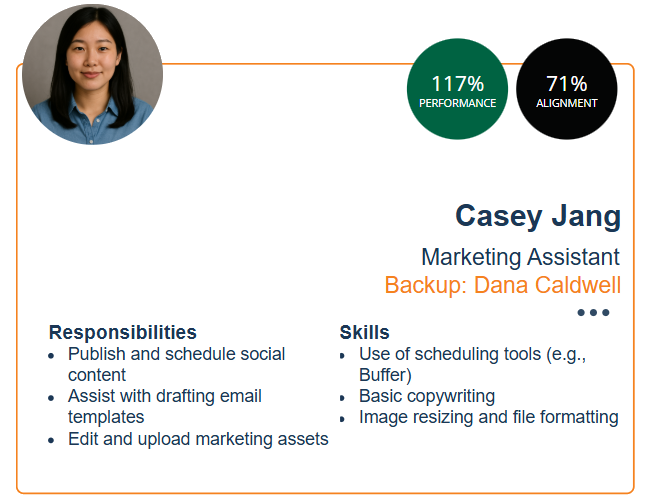
This connects directly to the Org Chart we discussed in the previous article.
Performance makes more sense when you understand what someone is actually responsible for.
If you can see the person’s position, responsibilities, skills, Metrics, and broader performance information together, you gain much more context.
Instead of asking:
Is this person performing?
You can ask:
How are they performing against what this position actually requires?
That’s a much better leadership question.
How Performance Scoring Creates a More Complete Picture
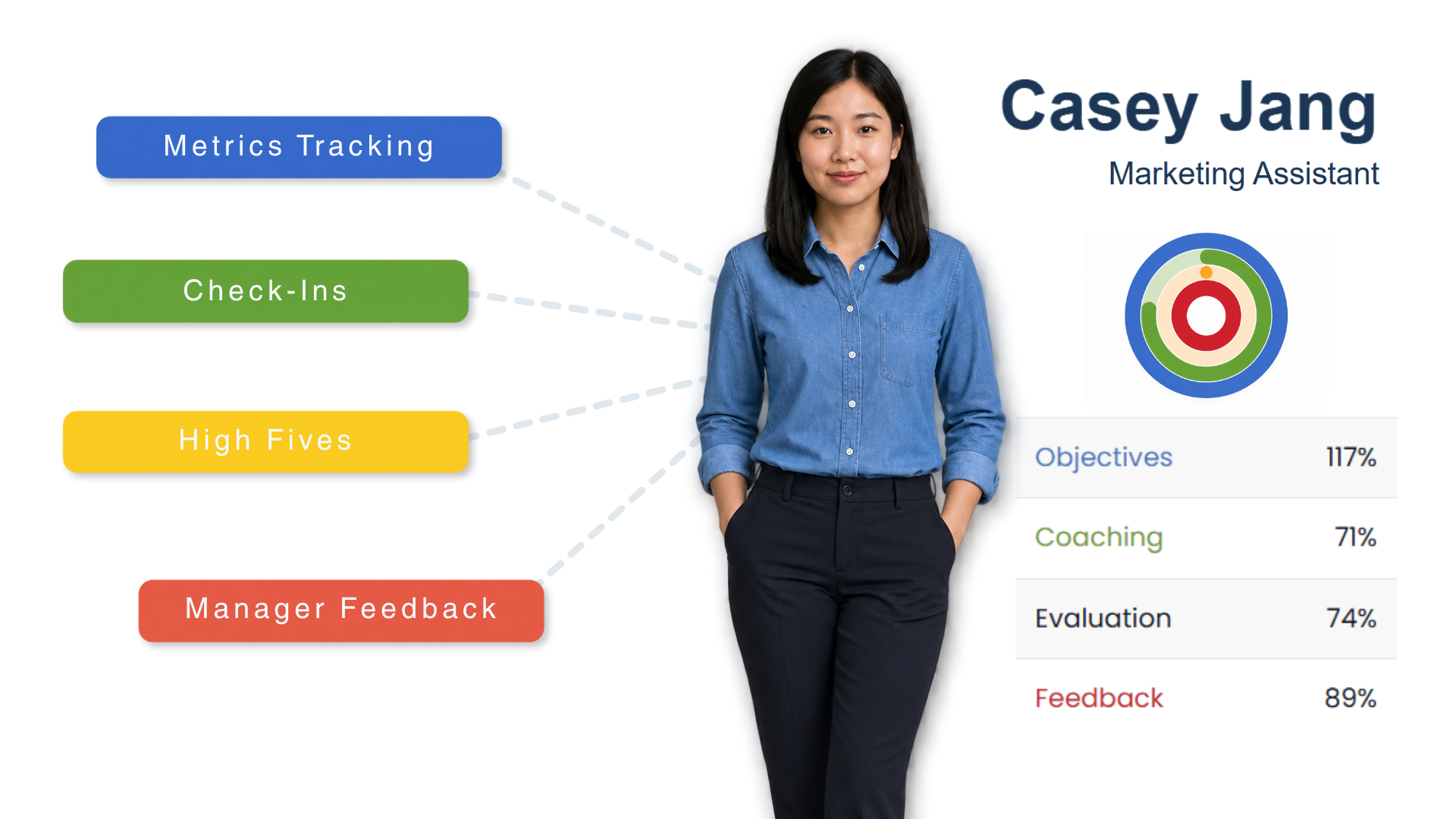
Performance Scoring brings multiple pieces of employee performance together so managers aren’t relying on a single snapshot.
Depending on how your organization uses the platform, leaders can gain visibility through areas such as:
Metrics to understand measurable performance.
Projects and Tasks to see execution and follow-through.
Org Charts to provide context around responsibilities and skills.
Performance Reviews for structured evaluation and development conversations.
Check-Ins for more frequent manager and employee communication.
Coaching to support improvement and development.
Feedback and High Fives to reinforce both improvement opportunities and positive contributions.
Performance, Alignment, and Engagement insights to provide additional signals about how someone may be doing.
Instead of trying to piece together employee performance from spreadsheets, emails, memory, and annual reviews, managers can build a more connected picture over time.
Put Your Performance Process to the Test
Think about one person on your team.
Then ask yourself:
If I had to explain how this person has been performing over the last 90 days, what would I use to support my answer?
Would you rely mostly on memory?
A few Metrics?
Your most recent conversation?
Their annual review?
Or could you see a broader history of results, progress, feedback, and conversations?
Then ask one more question:
Would the employee agree with your assessment?
If the answer might surprise you, that’s another reason regular visibility and communication matter.
Employees shouldn’t have to wait until a Performance Review to find out how their manager thinks they’re doing.
See the People More Clearly
This is the second article in Week 3: See the People of our September See Your Business More Clearly series.
We started by looking beyond the traditional Org Chart to better understand the structure, responsibilities, skills, and people behind the business.
Now we’ve added performance to that picture.
Next, we’ll explore:
Why Wait for the Annual Performance Review?
We’ll look more closely at how Performance Reviews, Check-Ins, feedback, and coaching can become an ongoing process that helps employees grow throughout the year instead of turning performance management into a once-a-year event.
Ready for a Clearer View of Employee Performance?
Performance Scoring brings your Metrics, Projects, Tasks, Performance Reviews, Check-Ins, Coaching, feedback, and people insights together to help managers better understand performance and have more meaningful conversations with their teams.
Visit PerformanceScoring.com or email us at support@performancescoring.com to learn more or take the 30-Day Business Challenge and experience the platform with your own team.
References and further reads:
- McKinsey & Company – Organizational Health: A Fast Track to Performance Improvement
McKinsey article - Harvard Business Review – Making Your Strategy Work on the Frontline
Harvard Business Review article - MIT Center for Information Systems Research – Build Business Advantage With Real-Time Decision-Making
MIT CISR article