Most businesses don’t have a shortage of meetings.
Leadership meetings. Team meetings. Department meetings. Project meetings. One-on-ones.
The real question isn’t:
Are you having meetings?
It’s:
What happens after them?
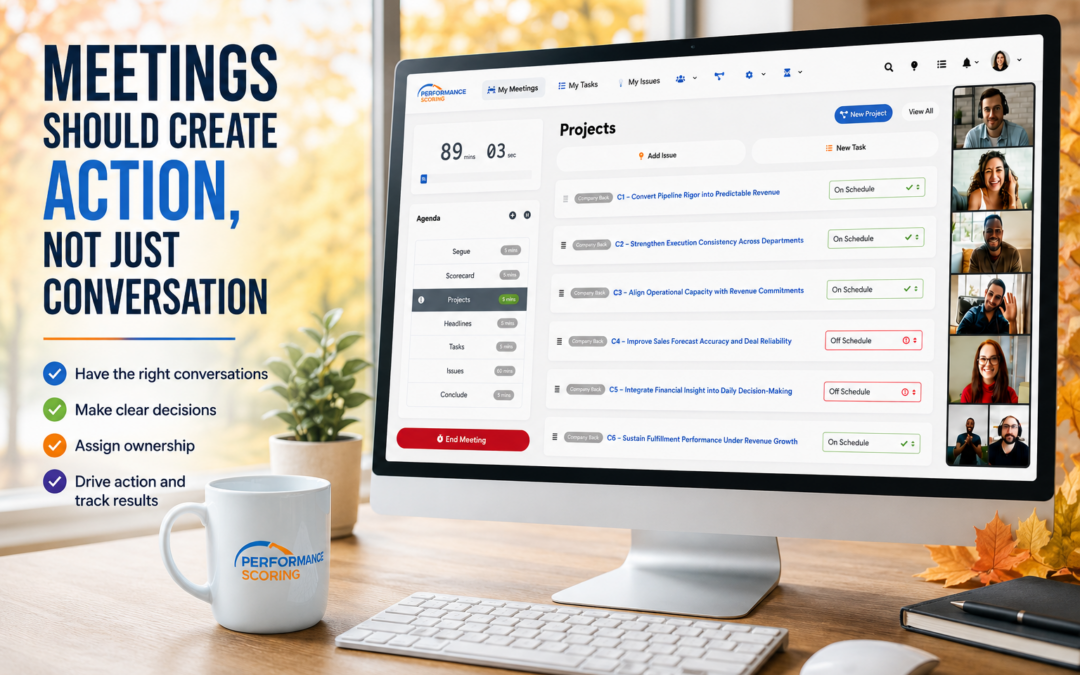
A productive meeting should do more than create conversation. It should help your team identify what’s happening, make decisions, assign action, and create accountability for what happens next.
Because if everyone walks out of the room and the work disappears into meeting notes, you’ve probably created another meeting instead of creating momentum.
A Good Meeting Should Move the Business Forward
Meetings are one of the places where strategy becomes execution.
They’re where leaders review what’s happening across the business, discuss obstacles, make decisions, and determine what needs to happen next.
But that only works when there’s a clear connection between the conversation and the work.
Think about how many times you’ve heard something like:
We talked about that last week.
Or:
Who was supposed to handle that?
Or the classic:
I thought someone was working on it.
Those aren’t necessarily communication problems.
They’re often visibility and accountability problems.
The Meeting-to-Action Gap
Imagine your leadership team identifies an issue during a weekly meeting.
Everyone agrees it needs attention.
There’s a great discussion.
Someone offers a solution.
The meeting ends.
Then Monday happens.
Emails arrive. Customers call. New priorities surface. Everyone returns to their regular responsibilities.
By the next meeting, someone asks:
Whatever happened with that?
This is the meeting-to-action gap.
The conversation happened, but the action wasn’t clearly connected to an owner, a Task, a deadline, or a larger priority.
Every Important Conversation Should Have a Next Step
Not everything discussed in a meeting requires action.
But when something does, the next step should be clear.
What needs to happen?
Who owns it?
When should it be completed?
Those three questions can dramatically change the effectiveness of a meeting.
Instead of leaving with a page full of notes, your team leaves knowing exactly what needs to happen next.
That’s where Tasks become important.
A decision made during a meeting can become an assigned Task with an owner and due date, creating a visible connection between discussion and execution.
Your Meetings Should Connect to the Rest of the Business
In our last article, we talked about connecting your Business Plan to the work happening throughout the organization.
Meetings are an important part of that connection.
Your leadership meeting shouldn’t exist in isolation from your Projects, Tasks, Metrics, and business priorities.
It should help you answer questions like:
- Are our most important Projects moving forward?
- Which Tasks are overdue?
- Are our key Metrics on track?
- What needs leadership attention?
- What obstacles are preventing progress?
- What decisions need to be made?
- Who owns the next step?
Now the meeting becomes more than a scheduled conversation.
It becomes part of your business execution system.
Stop Spending Meetings Gathering Updates
One of the easiest ways to lose valuable meeting time is to spend most of it figuring out what’s happening.
Where are we on this Project?
Did that Task get completed?
What was the Metric last week?
What did we decide about this last time?
When information is scattered across different tools, spreadsheets, emails, and notes, meetings can quickly become status-update sessions.
Better business visibility changes that.
When your team can see what’s on track, what’s off track, and what’s overdue before or during the meeting, you can spend less time gathering information and more time discussing what to do about it.
What About Everything Said During the Meeting?
There’s another challenge with meetings:
A lot gets said.
Important context can be buried inside an hour-long conversation. Someone has to take notes, capture decisions, remember follow-ups, and often send a recap afterward.
This is an area where technology can take some of the administrative burden off the team.
Performance Scoring brings AI transcription and meeting summaries into the meeting experience, helping capture the conversation and provide a clearer record of what happened.
That means your team can spend more time participating in the conversation instead of trying to document every detail.
Keep the History Without Starting Over
Recurring meetings also create valuable business history.
What was discussed last month?
When did this issue first come up?
What happened with the conversation from three meetings ago?
When meetings are treated as isolated events, that context can be difficult to recover.
Keeping meeting information connected over time gives leadership a better view of how conversations, decisions, and priorities have evolved.
It’s not just about documenting the meeting.
It’s about preserving the context behind the work.
From Meeting to Accountability
This is where Performance Scoring helps connect the pieces.
Instead of your meeting being separate from everything else happening in the business, it can become a central place for reviewing and moving the work forward.
Your team can bring together:
Meetings for discussion and decisions.
Projects for larger priorities.
Tasks for clear next steps.
Metrics for measurable performance.
Business Plans for strategic direction.
People performance for greater visibility into the team responsible for execution.
And AI can help capture and summarize the conversation happening along the way.
The result is a much clearer path:
See it → Discuss it → Decide → Assign it → Track it
Put Your Meetings to the Test
Here’s a simple question to ask after your next leadership meeting:
Could everyone clearly tell you what was decided, what happens next, and who owns it?
If the answer is yes, your meeting probably created action.
If the answer is no, consider what happens to your conversations after everyone leaves the room.
Are decisions documented?
Are Tasks assigned?
Are owners clear?
Can progress be tracked?
Will the next meeting start with visibility into what happened since the last one?
Because the value of a meeting isn’t measured by how much you discuss.
It’s measured by what happens next.
See the Work More Clearly
This article kicks off Week 2: See the Work in our September See Your Business More Clearly series.
We’ve already explored overall business visibility, business health, and connecting your Business Plan to execution.
Now we’re following that execution into the day-to-day work.
Next up:
Are Your Projects Actually Moving Forward?
We’ll look at how Projects and Tasks can give leadership greater visibility into progress, ownership, deadlines, and the work driving your biggest priorities.
Ready to Turn Meetings Into Action?
Performance Scoring connects Meetings, Projects, Tasks, Metrics, Business Plans, and people performance so your team can move from conversation to action without losing visibility along the way.
Visit PerformanceScoring.com or email us at support@performancescoring.com to learn more or take the 30-Day Business Challenge and experience the platform with your own team.
References and further reads:
- McKinsey & Company – Organizational Health: A Fast Track to Performance Improvement
McKinsey article - Harvard Business Review – Making Your Strategy Work on the Frontline
Harvard Business Review article - MIT Center for Information Systems Research – Build Business Advantage With Real-Time Decision-Making
MIT CISR article