Most businesses have Projects.
New initiatives. Internal improvements. Client work. Technology upgrades. Hiring plans. Marketing campaigns. Process changes.
There’s usually no shortage of things the company wants to accomplish.
The challenge is knowing:
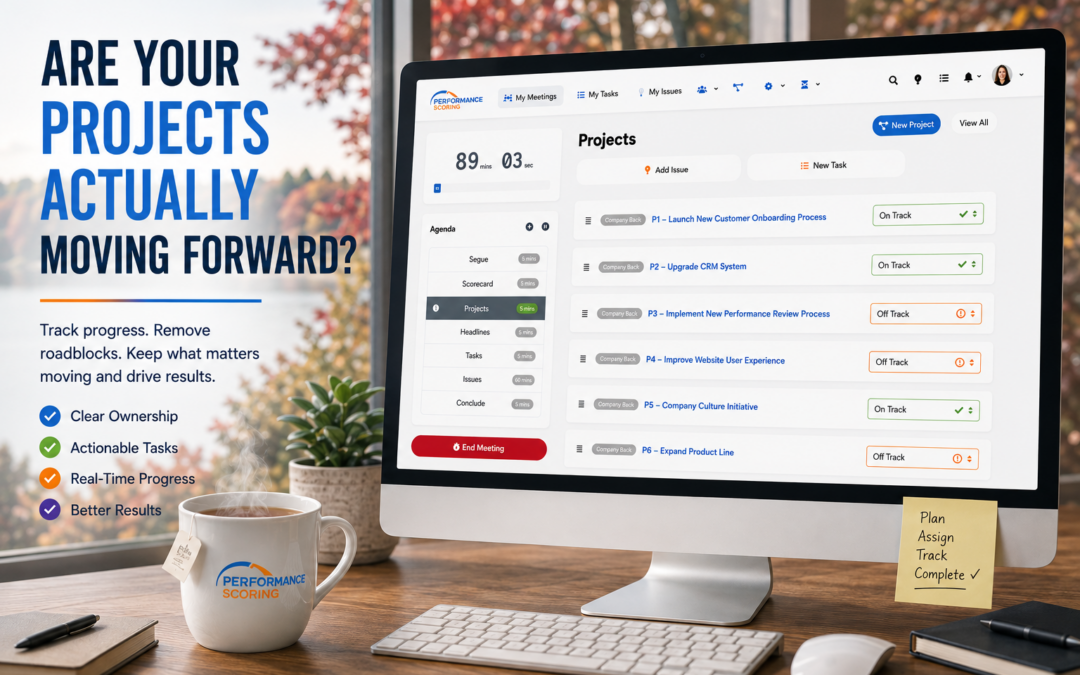
Are those Projects actually moving forward?
A Project can be important, discussed frequently, and assigned to someone, but that doesn’t necessarily mean it’s progressing.
That’s why project visibility matters.
Leadership shouldn’t have to wait until a deadline is missed to discover that an important priority has stalled.
Being Busy Isn’t the Same as Making Progress
Teams can be incredibly busy while their most important Projects barely move.
Emails are being answered.
Meetings are happening.
Tasks are getting completed.
Customers are being served.
Everyone is working.
But what about the Projects that are supposed to move the business forward?
That’s where leaders need to distinguish between activity and progress.
A long Task list can show that work is happening. It doesn’t necessarily tell you whether the right work is happening.
The better question is:
Are the things we’re doing moving our most important priorities forward?
Every Project Needs Clear Ownership
One of the easiest ways for a Project to stall is unclear ownership.
Everyone may agree that something needs to happen, but who is ultimately responsible for making sure it does?
When ownership isn’t clear, Projects can quickly become shared responsibilities that nobody truly owns.
A strong Project should make it easy to understand:
- What are we trying to accomplish?
- Who owns the Project?
- What needs to happen next?
- When does it need to be completed?
- Is the Project currently on or off track?
- What is preventing progress?
Clear ownership doesn’t mean one person has to do everything.
It means someone is responsible for making sure the Project continues moving.
Break Projects Into Actionable Tasks
A Project tells you what you want to accomplish.
Tasks tell you what needs to happen next.
That’s an important distinction.
Imagine your company has a Project to launch a new customer onboarding process.
The Project itself might take several weeks or months.
To move it forward, your team may need to:
Create the new onboarding workflow.
Update customer communications.
Build training materials.
Configure internal systems.
Train employees.
Test the new process.
Collect feedback.
Each of those actions can become a Task with an owner and deadline.
Now the Project isn’t just a big goal sitting on a list.
It’s connected to visible action.
Projects Shouldn’t Disappear Between Meetings
Think about what happens after your leadership team discusses an important Project.
Everyone agrees on the next steps.
The meeting ends.
Then the regular workweek takes over.
By the time the next meeting arrives, leadership needs another status update just to figure out what happened.
This is why Projects, Tasks, and Meetings shouldn’t operate independently.
Your meetings should help identify what needs attention.
Your Projects should show the larger priorities.
Your Tasks should show the actions required to move them forward.
Then the next meeting can focus on progress, obstacles, and decisions rather than trying to reconstruct what happened during the week.
On Track or Off Track?
Sometimes the most valuable piece of information leadership needs is also the simplest:
Is this Project on track?
If yes, great.
Leadership may not need to spend much time discussing it.
If no, that’s where the conversation begins.
Why is it off track?
Is there an obstacle?
Does the owner need help?
Has the priority changed?
Is a decision needed?
Do resources need to be shifted?
Better project visibility doesn’t mean leadership needs to get involved in every detail.
It means leaders can more quickly identify where their attention is actually needed.
The Red Isn’t the Problem
Seeing something marked off track can make teams uncomfortable.
But the red status isn’t the problem.
The problem already exists.
The status simply makes it visible.
That’s an important mindset shift when creating greater visibility across a business.
An off-track Project isn’t automatically a failure. It can be an early signal that something needs attention.
The earlier leadership sees that signal, the more opportunity there is to respond before a missed milestone becomes a missed goal.
Visibility gives your team an opportunity to ask:
What’s getting in the way, and what do we need to do next?
Connect Projects to the Bigger Picture
Projects shouldn’t exist simply because someone had a good idea.
Ideally, your most important Projects connect back to something the business is trying to accomplish.
Maybe it’s a company goal.
A strategic priority.
An Initiative.
A Metric you’re trying to improve.
A customer experience issue.
A people or process improvement.
When Projects connect to the larger Business Plan, teams gain greater context around why the work matters.
This brings us back to the connection we’ve been building throughout this series:
Business Plan → Projects → Tasks → Metrics → Meetings → People
The more connected those pieces become, the easier it is for leadership to see whether strategy is turning into execution.
How Performance Scoring Creates Project Visibility
Performance Scoring brings Projects into the same environment where your team manages other important parts of the business.
Instead of Projects existing in one system while Tasks, Meetings, Metrics, and performance information live somewhere else, leaders can create a more connected view of the work.
Your team can use Projects to track larger priorities and progress.
Use Tasks to identify the specific actions required to move them forward.
Use Meetings to review progress, discuss obstacles, and make decisions.
Use Metrics to understand whether the work is producing the intended results.
And connect that work back to your broader Business Plan and company priorities.
The goal isn’t simply to manage Projects.
It’s to make progress easier to see.
Put Your Projects to the Test
Take a look at your company’s five most important Projects right now.
Then ask:
Can I immediately tell whether each one is moving forward?
Do you know who owns each Project?
Can you see what’s on track and what’s off track?
Can you identify the next actions?
Can you see which Tasks are overdue?
Would you know if something hadn’t moved in two weeks?
And most importantly:
Can you see how each Project connects to what the business is trying to accomplish?
If those answers aren’t immediately clear, you may not have a Project problem.
You may have a visibility problem.
See the Work More Clearly
This is the next article in Week 2: See the Work of our September See Your Business More Clearly series.
We’ve looked at how meetings can turn conversations into decisions and action.
Now we’ve connected those actions to the Projects driving your company’s priorities.
Next, we’ll look at another important piece of the picture:
Are You Measuring What Actually Matters?
We’ll explore how Metrics can help leaders move beyond gut instinct and create a clearer, measurable view of what’s working, what’s changing, and where attention may be needed.
Ready to See What’s Moving and What’s Not?
Performance Scoring connects your Projects, Tasks, Meetings, Metrics, Business Plan, and people performance so leadership can see more than what’s getting done.
You can see whether the work that’s supposed to move your business forward is actually moving.
Visit PerformanceScoring.com or email us at support@performancescoring.com to learn more or take the 30-Day Business Challenge and experience the platform with your own team.
References and further reads:
- McKinsey & Company – Organizational Health: A Fast Track to Performance Improvement
McKinsey article - Harvard Business Review – Making Your Strategy Work on the Frontline
Harvard Business Review article - MIT Center for Information Systems Research – Build Business Advantage With Real-Time Decision-Making
MIT CISR article