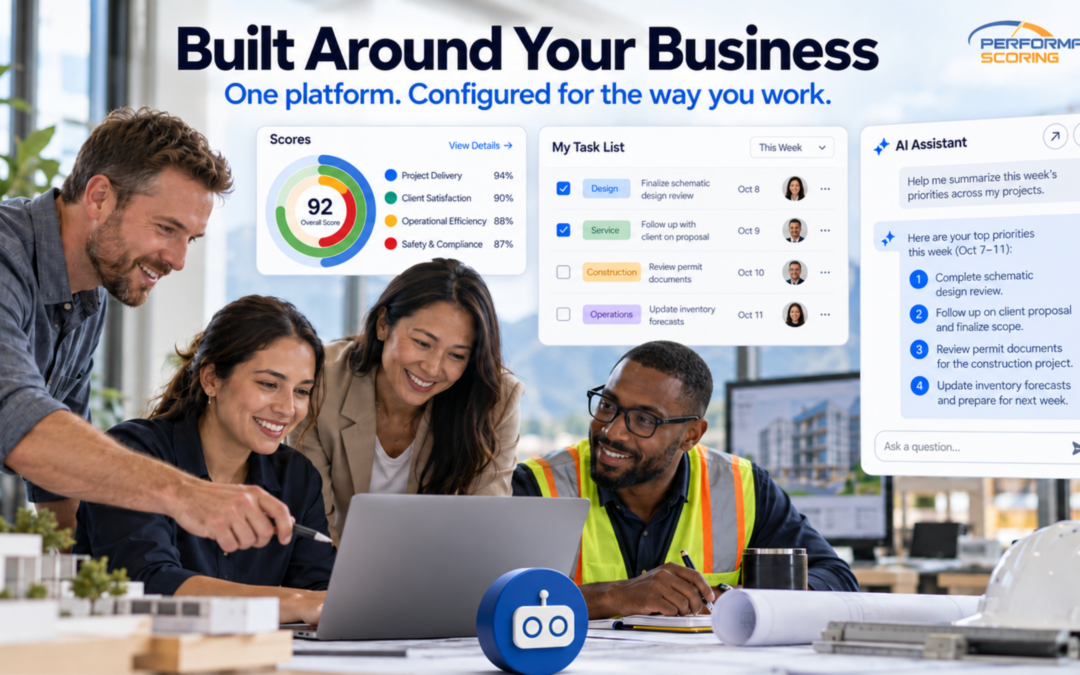
One thing becomes pretty obvious when you work with different businesses: no two companies operate exactly the same way.
That’s why software built around your business can be far more effective than forcing your team into a one-size-fits-all system.
So why do we so often expect every company to operate inside the exact same system?
The Process Should Support the Business
There’s a tendency when implementing new software to start with the tool.
Here are the features.
Here are the fields.
Here’s what we call everything.
Here’s the process you need to follow.
Then the business is expected to adjust.
But that can create more work instead of less.
People start translating the terminology in their heads. Teams build side spreadsheets because the system doesn’t quite capture what they need. Managers create workarounds. Before long, the company has another piece of technology to maintain instead of a tool that actually makes things easier.
A better starting point is much simpler:
How does your business already work?
What does your leadership team need to see?
What information helps managers make decisions?
What does accountability look like inside your organization?
What are the measurements that actually tell you whether things are going well?
Technology should help organize those answers, not dictate them.
“Performance” Means Something Different Everywhere
Think about how different performance can look across industries.
For a service company, important measurements might include response time, completed service calls, first-time fix rate, callbacks, or customer satisfaction.
A financial institution may be looking at loan production, branch performance, compliance, customer retention, or service standards.
A law firm might care about case progress, billable hours, deadlines, client communication, and workload.
A warehouse operation may be focused on inventory accuracy, shipping times, picking efficiency, safety, and staffing.
An architecture or engineering firm could be tracking project deadlines, client approvals, design reviews, utilization, and project profitability.
None of those businesses are wrong.
They simply need different information.
And that’s really the point.
A useful business system shouldn’t determine what success looks like for you. It should give you a better way to see and manage the things that already matter.
Language Matters More Than We Think
Terminology is another piece that often gets overlooked.
Every organization develops its own language.
One company calls them projects. Another calls them initiatives. Another calls them jobs.
Some teams talk about KPIs. Others use metrics, goals, scorecards, or targets.
Even something as simple as a task can mean something different depending on the company.
That may sound like a small detail, but it affects adoption.
When people open a new system and immediately recognize the language they already use, there’s less friction.
They don’t have to learn the software and translate the software at the same time.
The technology starts feeling like part of the business instead of something sitting on top of it.
Setup Is Part of the Strategy
I also think there’s a misconception that implementing software means turning it on and giving everyone a login.
The more important work happens before that.
What should leadership be tracking?
Which information belongs at the company level versus the individual level?
What should managers see every week?
Where are things currently falling through the cracks?
What needs to become easier to find?
Which processes are working well and should stay exactly as they are?
Those conversations are where a system begins becoming useful.
Sometimes the answer isn’t adding more.
It’s simplifying.
Sometimes a company has twenty measurements when leadership really needs five.
Sometimes several processes can be brought together.
Sometimes the biggest improvement is simply giving everyone one place to see what they’re responsible for.
The goal isn’t to recreate every process inside a piece of software.
The goal is to make the important parts of the business clearer.
There Is No Perfect Template
Templates can be helpful.
Best practices can be helpful.
Seeing how other organizations operate can absolutely give you ideas.
But eventually, every company has to decide what works for its people.
That’s something I’m reminded of constantly.
The companies that get the most value from their systems usually aren’t the ones trying to use every possible feature.
They’re the ones that have been thoughtful about what they actually need.
They know what they want their teams paying attention to.
They know what information helps leadership make decisions.
And they build around that.
Because at the end of the day, good technology should feel less like another system your team has to manage and more like an extension of the way your business already operates.
Your business is unique. The tools supporting it should leave room for that.
give me 5 high-end references to go at the bottom of this article as References and further reads
Worked for 16s
References & Further Reading
- Harvard Business Review — “Tech Should Enable Change, Not Drive It”
A strong companion to the idea that technology should support how people and organizations work, rather than dictate the process. Harvard Business Review
Read at Harvard Business Review - Harvard Business Review — “Digital Transformation Is About Talent, Not Technology”
Explores why successful transformation depends as much on people, culture, and adaptability as it does on the technology itself. Harvard Business Review
Read at Harvard Business Review - McKinsey & Company — “Five Key Questions to Get a Tech Transformation Right”
Looks at aligning technology, operating models, business priorities, and the end-user experience. McKinsey & Company
Read at McKinsey & Company - Prosci — “How to Apply Change Management to Technology Transformation”
Focuses on the people side of technology implementation and why adoption is essential to realizing value from new systems. Prosci
Read at Prosci - Deloitte / Harvard Business Review — “If You Want Your Digital Transformation to Succeed, Align Your Operating Model to Your Strategy”
Connects technology decisions with organizational structure, business strategy, metrics, and the way work actually gets done. Note that this is Deloitte-sponsored content published through HBR. Harvard Business Review
Read at Harvard Business Review