AI meeting note takers are everywhere.
They record meetings, transcribe conversations, and generate polished summaries in seconds.
That’s impressive.
But here’s the real question every business leader should be asking:
What happens after the meeting ends?
Because meeting notes don’t move projects forward.
Tasks do.
Most AI Stops at Documentation
Today’s AI note takers are excellent at capturing what was said.
You’ll receive a transcript.
You’ll get a summary.
You might even see a list of suggested action items.
But then someone still has to read the summary, decide who owns each task, manually create the tasks, assign deadlines, and follow up to make sure the work gets done.
That’s not automation.
That’s another administrative task.
Great Meetings Create Action
Think about your last leadership meeting.
You probably discussed important decisions, delegated work, solved problems, and agreed on next steps.
Now ask yourself:
Did your AI simply document those decisions, or did it actually help your team execute them?
There’s a big difference.
The best meetings don’t end with a summary.
They end with clear ownership.
AI Should Eliminate Work, Not Create More
The real promise of artificial intelligence isn’t writing better meeting notes.
It’s reducing manual work.
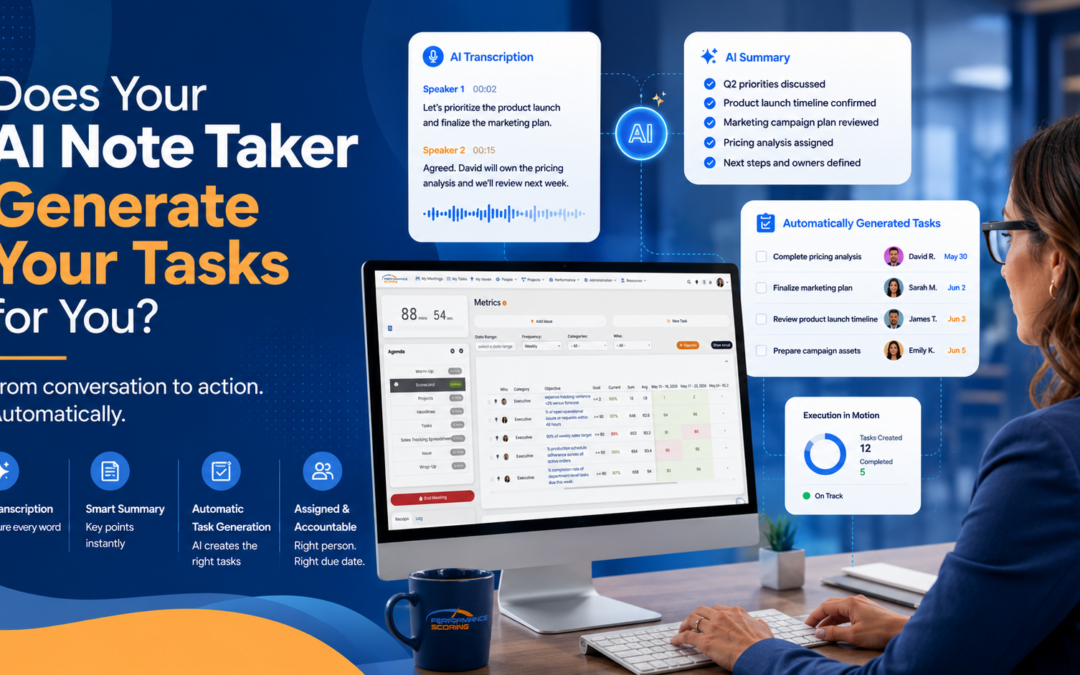
Imagine finishing a meeting and having AI automatically identify commitments made during the discussion, generate the right tasks, assign each task to the right team member, capture due dates, and place everything into your organization’s workflow before anyone leaves the meeting.
No copying and pasting.
No forgotten action items.
No wondering who was supposed to do what.
That’s where AI starts delivering real business value.
Accountability Doesn’t Happen by Accident
Many organizations struggle with execution because follow-up depends on people remembering what happened in the meeting.
Someone forgets.
Someone gets busy.
Someone assumes another person owns the task.
Before long, important priorities begin slipping through the cracks.
When AI automatically creates assigned tasks from meeting conversations, accountability becomes part of the process instead of an afterthought.
The Future of AI Meetings
AI transcription is becoming a standard feature.
Meeting summaries are becoming a standard feature.
The next generation of AI goes further.
It helps teams execute.
Instead of simply documenting conversations, it turns discussions into action.
That’s the difference between AI that records meetings and AI that helps organizations improve performance.
Ready to See AI That Does More Than Take Notes?
At Performance Scoring, we believe AI should save time and improve execution, not create another step in your workflow.
That’s why our AI doesn’t stop at transcription and meeting summaries. It helps generate the tasks your team needs to keep work moving and accountability high.
If you’re ready to experience the difference, take our FREE 30-Day Business Challenge.
You’ll see how AI meeting transcription, intelligent summaries, automatic task generation, performance management, and accountability all work together in one platform.
Take the challenge today and discover how much more productive your meetings can become.
References & Further Reading
McKinsey & Company – The State of AI
Research on how organizations are adopting AI to improve productivity and business performance.
https://www.mckinsey.com/capabilities/quantumblack/our-insights/the-state-of-ai
Microsoft WorkLab – AI at Work
Research and articles on AI productivity, collaboration, and the future of work from Microsoft’s WorkLab.
https://www.microsoft.com/worklab
MIT Sloan Management Review – Artificial Intelligence
Thought leadership on AI implementation, leadership, organizational performance, and business strategy.
https://sloanreview.mit.edu/tag/artificial-intelligence/