Every organization has systems. Few have an operating system.
A Business Operating System (BOS) is the integrated framework that connects how a company plans, executes, measures, and improves its work. It’s not just software—it’s the combination of processes, data, and behaviors that keep strategy aligned with daily execution.
For years, companies could get by with disconnected tools: one for meetings, another for goals, another for projects, another for performance reviews. That approach no longer works. The pace of change, distributed teams, and constant decision pressure have made fragmentation a liability.
What a Business Operating System Really Does
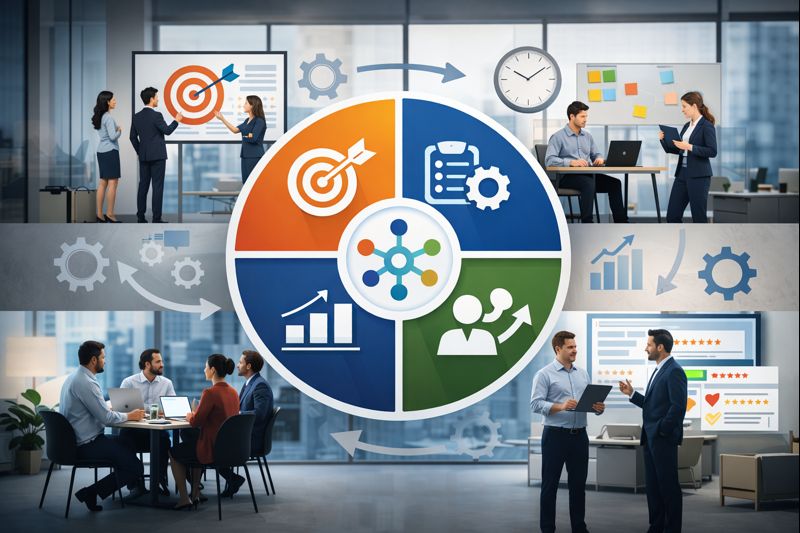
A true BOS sits at the center of the organization and answers four critical questions—continuously:
- What are we trying to achieve?
Clear goals, priorities, and success metrics. - How are we executing?
Projects, tasks, ownership, and progress tracking. - How are people performing?
Real-time feedback, coaching, and objective performance data. - Are we aligned right now?
Not quarterly. Not annually. In the meeting you’re having today.
Modern platforms like Performance Scoring bring these elements together by anchoring them in Meeting Management, where decisions are made, work is reviewed, and accountability actually happens. Meetings become the operating heartbeat, not a time drain
Why a BOS Is More Crucial Than Ever
1. Work Is Faster—and Less Forgiving
Research from MIT Sloan shows that digitally mature organizations outperform peers precisely because they integrate data, decision-making, and execution instead of treating them as separate functions
Without a BOS, leaders operate on stale information. With one, teams adjust in real time.
2. Meetings Are Where Alignment Is Won or Lost
Harvard Business Review reports that executives now spend up to 23 hours per week in meetings, yet many still lack clarity on outcomes and accountability
A BOS ensures meetings aren’t just conversations—they’re moments where goals, projects, and performance data converge into action.
From Tools to Operating System
The difference between software and a BOS is integration with intent.
When goal tracking, project execution, and performance feedback live inside one system, leaders stop chasing updates and start leading. Platforms like Performance Scoring connect:
- Performance Management with real-time, objective scoring
- Employee Engagement through continuous feedback and coaching
- Execution and accountability directly into meetings, where teams already work
This matters because Gallup consistently finds that engaged employees drive higher productivity and profitability—but engagement only happens when expectations, feedback, and recognition are clear and frequent
The Bottom Line

A Business Operating System isn’t a “nice to have.” It’s the infrastructure modern organizations need to stay aligned, agile, and accountable.
If your strategy lives in slides, your goals live in spreadsheets, your projects live in task tools, and your meetings live in calendars—you don’t have a system. You have noise.
The organizations that win next will be the ones that unify execution, performance, and alignment under a single operating rhythm—starting with their meetings.
Ready to get started? Request a free Demo today!