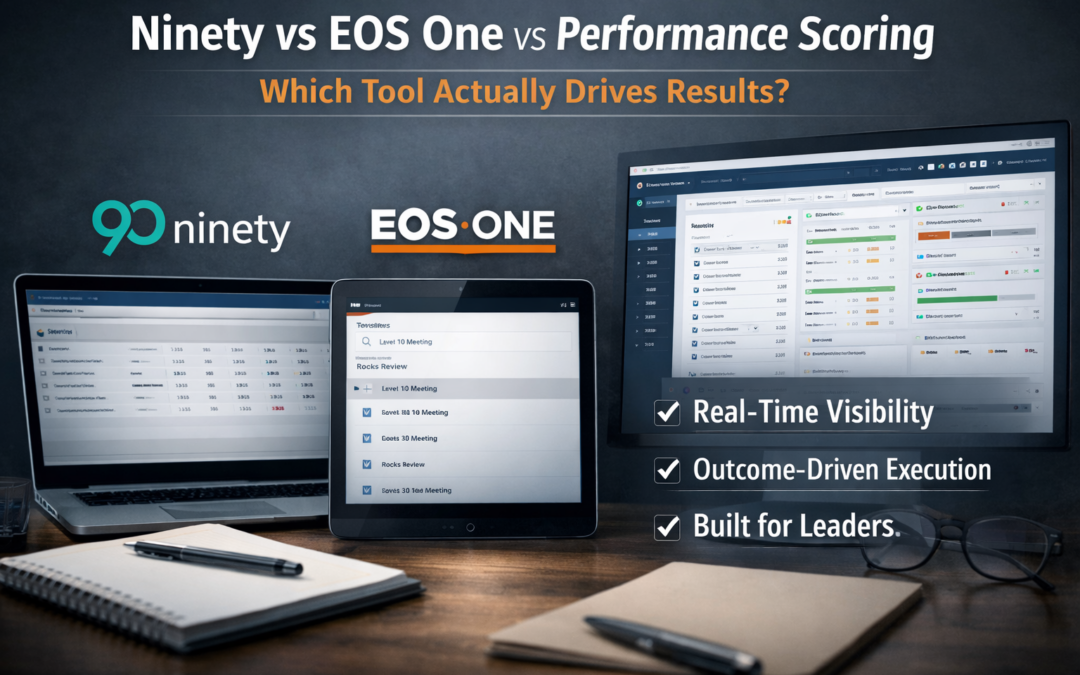
As more leadership teams adopt EOS®, the market has filled with software platforms claiming to “support” the system. Two of the most well-known are Ninety and EOS One. Both offer structure, documentation, and meeting support.
But here’s the real question most leaders should be asking:
Which tool actually drives results between meetings?
Because EOS doesn’t succeed in the meeting room—it succeeds in execution.
Let’s take an honest look at Ninety, EOS One, and Performance Scoring, and why more teams are choosing Performance Scoring when results matter most.
The Real Job of EOS Software
Before comparing tools, it’s important to clarify what EOS software should do.
EOS software should:
- Create clarity around priorities and metrics
- Reinforce accountability every day, not just weekly
- Reduce administrative overhead
- Help leaders see problems sooner and act faster
Tracking EOS components isn’t enough. The software must change behavior.
Side-by-Side Comparison
| Feature | Ninety | EOS One | Performance Scoring |
|---|---|---|---|
| EOS Alignment | Strong structure | Official EOS tool | Deep, practical EOS execution |
| Primary Focus | Documentation & meetings | EOS component tracking | Execution & performance |
| Scorecards | Static, meeting-based | Manual updates | Real-time, dynamic |
| Rocks Tracking | Status-focused | Check-the-box | Outcome-driven |
| Leadership Visibility | Fragmented views | Meeting-dependent | Always-on clarity |
| Flexibility | Low | Medium | High |
| Daily Execution Support | Limited | Limited | Core strength |
Ninety: Strong Structure, Limited Execution
Ninety does a good job organizing EOS components. For teams that want a clean digital binder, it works well.
Where teams struggle:
- Updates often happen only during meetings
- Execution between meetings still lives in spreadsheets, emails, or side tools
- Leaders must dig to understand what’s truly on track
Bottom line: Ninety supports EOS process, but not EOS momentum.
EOS One: Official, but Rigid
EOS One benefits from being the official EOS® software, and it aligns cleanly with the framework’s terminology and structure.
However:
- It’s heavily meeting-centric
- Updates require discipline and manual input
- Leaders often lack real-time insight into performance
Many teams find EOS One works best as a record-keeping system, not a performance engine.
Bottom line: EOS One tracks EOS, but doesn’t actively drive execution.
Performance Scoring: Built for Results, Not Just Compliance
Performance Scoring was designed for one purpose:
to help leadership teams execute better, faster, and with less friction.
What makes it different?
1. Real-Time Performance Visibility
Metrics, priorities, and accountability are visible as work happens—not a week later in a meeting.
2. Execution Between Meetings
Performance Scoring focuses on the work that happens outside the Level 10™ meeting, where results are actually created.
3. Outcome-Driven Rocks
Rocks aren’t just “on track or off track.”
They’re connected to real progress, ownership, and measurable outcomes.
4. Leadership-Centric Design
Executives don’t need to hunt for answers.
Performance Scoring surfaces what matters most—clearly and immediately.
5. Flexibility Without Losing EOS Discipline
Unlike rigid platforms, Performance Scoring adapts to how teams actually operate while still reinforcing EOS principles.
Bottom line: Performance Scoring turns EOS into a living operating system, not a weekly ritual.
Which Tool Actually Drives Results?
If your goal is:
- To document EOS → Ninety or EOS One can work
- To run meetings → Any of the three will help
- To drive execution, accountability, and clarity every day → Performance Scoring stands apart
EOS succeeds when leaders can:
- See reality clearly
- Act quickly
- Hold the right people accountable—without friction
That’s exactly what Performance Scoring was built to do.
Final Thought
EOS isn’t a checklist.
It’s a performance system.
The teams seeing the strongest results aren’t just tracking EOS—they’re operating inside it every day. And that’s why more leadership teams are choosing Performance Scoring over Ninety and EOS One.
Additional Reads and References:
What is EOS? A Comprehensive Guide — A structured explanation of the EOS framework, its components, and how it helps businesses improve performance and alignment.
https://zdkinnovations.com/eos-entrepreneurial-operating-system-a-comprehensive-guid/
ScienceDirect. Enhancing team performance: A multilevel model. Journal of Cleaner Production.
This academic study proposes and tests a multilevel model of team performance, showing how leadership support, shared vision, and collective efficacy contribute to team effectiveness — reinforcing the importance of leadership design in performance outcomes.
Enhancing team performance: A multilevel model – ScienceDirect
HBR’s 10 Must Reads on Performance Management (Harvard Business Review Press) — A curated collection of top leadership and performance management insights from Harvard Business Review authors, including topics like aligning goals, using people analytics ethically, and improving performance processes.
Harvard Business Review Press – HBR’s 10 Must Reads on Performance Management
https://hbr.org/products/collections/performance-management